
Obamacare may be path to drug treatment as prison alternative

Screen Shot 2014-03-30 at 6.39.36 PMMarch 31, 2014

The Justice Department estimates suggest that with the expansion of Medicaid, millions of ex-offenders could get the health care they need. They claim is predicated on the exoffender accessing the medical services now available to them.

A Newsweek Cover Article states that  “President Ronald Reagan defunded federal mental health programs, dropping total mental health spending by over 30 percent. As a result, many of the nation’s mentally ill lost what was essentially their home and place of work, and many ended up on the street.Today, a good portion of those make their beds in prisons and jails. The last major study on mental health in prisons, conducted by the Bureau of Justice Statistics, found that 64 percent of inmates in state and federal prisons met the criteria for mental illness at the time of their booking or during the twelve months leading up to their arrest. For comparison, the rate of mental disorders among U.S. citizens stands at around 25 percent, according to the NIH. Sixty-nine percent of the country’s prison population was addicted to drugs or alcohol prior to incarceration.”

Grim statistics, but the article argues that the Obamacare expansion of Medicaid will reach those with mental health and drug abuse for the first time as an alternative to incarceration.

“Essentially, Medicaid left out poor, single, male adults without dependant children. – the same demographic most likely to end up arrested and incarcerated. Starting in January 2014, however, the categories have been eliminated (at least in the states that have chosen to take the medicaid expansion – it is an optional aspect of the ACA). “That means that a lot of people who are going to jail for mental illness or substance abuse related crimes could potentially avoid jail,” says Marsha Regenstein, a professor of health policy at George Washington University.


Prison Numbers Drop while Crime Rates Drop!.

March 24, 2014Screen Shot 2014-03-25 at 12.05.08 PM

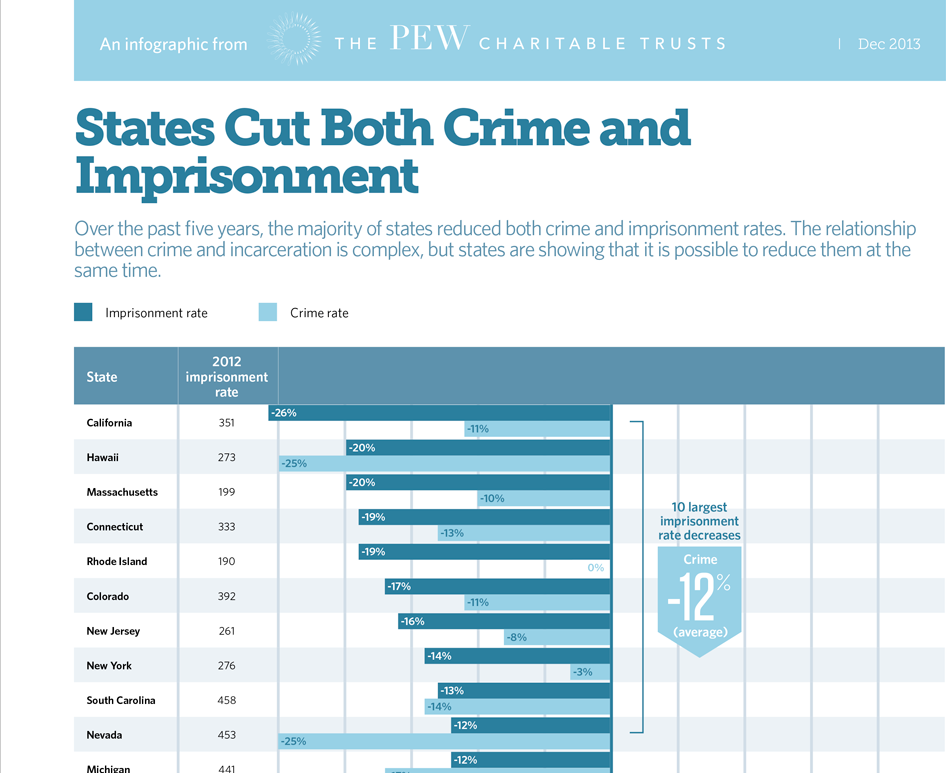
Recent statistics from across the nation suggest that criminal justice reform has become a win-win proposition. The Pew Trust, a highly respected authority, has examined data from all fifty states and concluded that morel than half of the states have reductions in both rates of imprisonnmet and crime over the past five years.

Breaking the data down further , PEW  shows even more impressive results:

  • The crime rate went down in all but four of the 31 states that reduced their imprisonment rates. It went up in one of the 15 states that increased their imprisonment rates.
  • The 10 states with the largest decreases in imprisonment rates had a 12 percent average reduction in their crime rates, and, in the 10 states with the largest imprisonment rate increases, crime rates fell an average of 10 percent (see table below).
  • Crime was down in states that continued with (and paid for) rapid prison growth, as well as those that did not. For example, crime rates in both Arizona and Maryland fell 21 percent from 2007 to 2012. Over the same period, Arizona’s imprisonment rate grew 4 percent while Maryland’s declined 11 percent.

PEW claims that the results reflect several factors; bipartisan support for reduced imprisonment and accompanying reduced prison budgets; strong public support for elimination of imprisonment for non-violent offenders; and evidence based alternatives to prison that have had significant success.

The success of reducing imprisonment and reliance on evidence based alternative to imprisonment are srong indicators that we’re moving in the right direction, and need to increase our embrace of criminal justice reform.

[The PEW article that this story is based on can be found by clicking on the Table above]


DOJ: small drop in fed. prison pop.

Screen Shot 2014-03-05 at 8.14.33 PMMarch 17, 2014

According to the Department of Justice Prisons Director Charles Samuels, there has been an “unprecedented” fall in prison numbers. He made the statement to a meeting of the US Sentencing Commission in Washington this week to consider across-the-board cuts to penalty guidelines for drug crime.

The Guardian reported this week ” The commission projects that downgrading the lengths of sentences in this way will eventually allow the Bureau of Prisons – the largest corrections department in the country – to reduce its population by 6,550 inmates at the end of five years.

“Though the numbers are small relative to the federal prison population of 216,000, and the 1.3m in state prisons, they suggest that shifts in prosecutions policy are already bringing an end to the long-running boom in prison numbers, particularly for more serious crimes tried in federal courts. There are more than 2 million Americans behind bars when county jails are included. While the total prison population has been declining for three years, the federal prison population had continued to grow.”

Federal prison populations going down is obviously good news. But it would be a mistake to view a onepercent drop in federal prison numbers as a substantial movement toward reform  when the number of federal prisoners has increased astronomically over the past thirty years.

According to a new report by the Congressional Research Service (CRS), the federal prison population has jumped from 25,000 to 219,000 inmates, an increase of nearly 790 percent over that thirty year period.

That is not to denigrate this adminstration efforts towards reform, but it points to the difficult path required to have a major impact on the number of federal prisoners..


Cal counties increase prison sentences

Screen Shot 2014-03-13 at 4.04.08 PMMarch 10, 2014

California is seeing a real increase in the number of offenders sent to its prisons, according to a recent article  by the Associated Press, “Counties, where prosecutors have discretion in filing such charges, sent nearly 5,500 people with second felony convictions to state prisons during the 2013-14 fiscal year, a 33 percent increase over the previous year and the most since California enacted the nation’s first three-strikes law in 1994 that required life sentences for offenders convicted of three felonies.””

This is an unwelcome consequence to prison reform that required less serious offenders remain in-county, to be dealt with by county jails and supervision. Depending who you talk to you will hear different explanations. Prosecutors blame it on an increase in crime. Sheriff’s offices claim that serious offenders who should have been sent to prison in the first place, are getting their due.  Public Defenders claim that their clients are the victim of local economics and a lack of space in local jails.

The numbers seem to favor  the latter view, with counties that have traditionally sent the most offenders to prison (often with the most limited supervision and jail resources), returning to their pattern  of moving criminals out  of county to be paid for by state taxpayers. “Merced County more than tripled the number of second-strikers, from 23 to 79. The number doubled in Placer and San Joaquin counties and climbed 88 percent in Stanislaus County.”

Judges appear to be at the center of the prison reform reversal,  According to the AP story, “Judges are imposing longer prison sentences for drug, property and other nonviolent crimes since criminal justice realignment became law, according to an analysis by the corrections department. Those sentences are increasing even as the length of sentences for violent crimes declined, leading to a net increase of 3.3 months in the average prison sentence since realignment.”

But this is a story with no clear culprit. D.A.s and judges are limited to six month jail terms (actually 90 days with credits) for jailed prisoners who violate their conditions of parole. Some claim that D.A.s and the courts are reacting to the lack of significant sanctions for less serious offenses. If so, local attitudes and economics may make prison reduction harder than anyone expected.

DOJ Budgets $173 million for Reform

Screen Shot 2014-03-05 at 8.14.33 PM

March 2, 2014

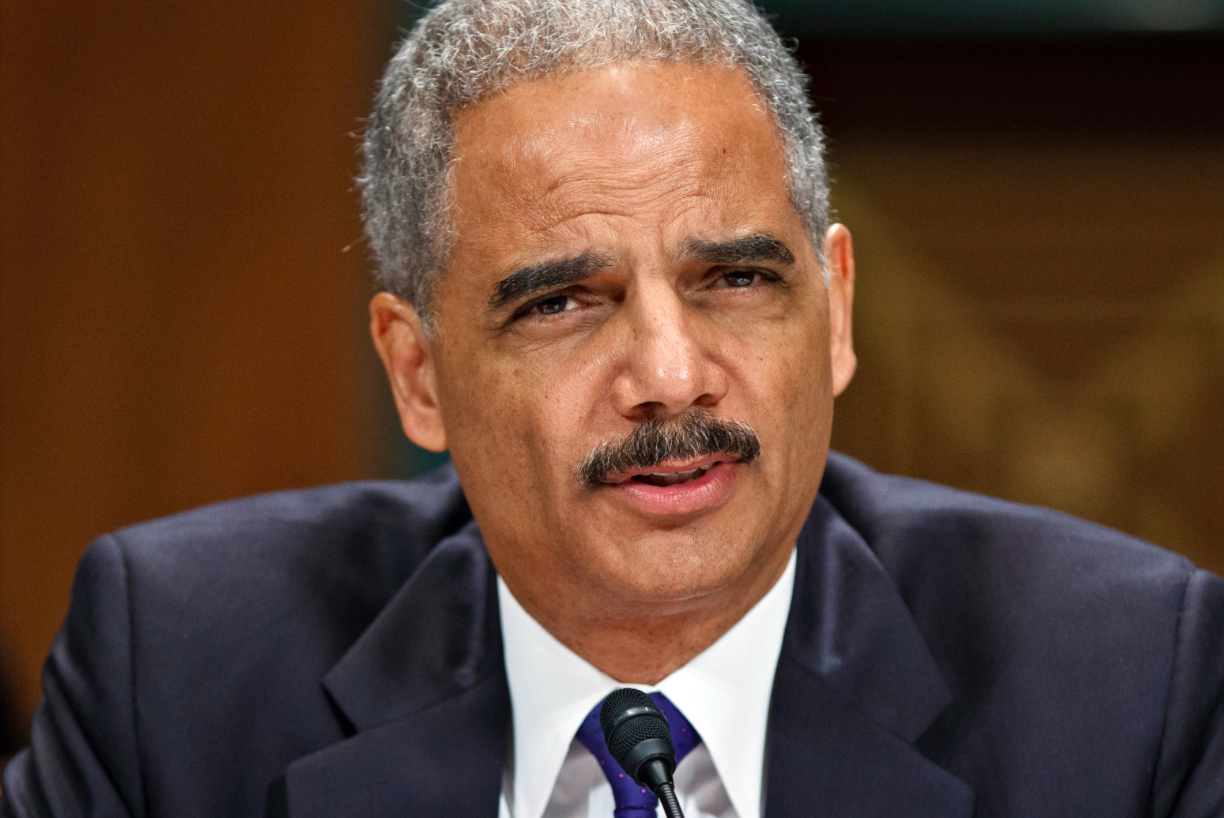
Eric Holder is making good on his promise  to double down on funding for criminal justice reform. Holder’s budget — $122 million above the 2014 enacted level — includes $173 million in targeted investments for criminal justice reform efforts.

As reported in the Washington Post, “The DOJ budget requests funding for Holder’s “smart on crime” initiative to reduce the number of low-level drug offenders in prison and reduce recidivism rates by expanding drug treatment programs.”

It requests $15 million for U.S. attorneys, including prevention and reentry work and promoting alternatives to incarceration such as the establishment of drug courts and veteran courts.

Another $15 million would go towards expanding the federal residential drug abuse program, and $14 million would assist inmates with reentering society and reducing the population of individuals who return to prison after being released. An additional $14 million would expand the residential substance abuse treatment program at the state and local levels.

The DOJ budget also requests $115 million for the Second Chance Act grant program to reduce recidivism and help ex-offenders return to productive lives.

“Each dollar spent on prevention and reentry has the potential to save several dollars in incarceration costs,” Holder said in a statement.

“These wise investments can help make our criminal justice system more effective and efficient.”

© 2007 -  Reentry Court Solutions. All Rights Reserved.


Reentry Court Solutions Powered by Communications Team