

Judge Surbeck Receives “Judicial Excellence Award”

Nov. 26,2012

[Continued from last week]

On Nov. 15th, Chief Justice of the United States John G. Roberts Jr. presented the  2012 William H. Rehnquist Award for Judicial Excellence, to Judge John Surbeck during a ceremony at the U.S. Supreme Court in Washington, D.C.

I had the opportunity to talk to Judge Surbeck recently about his Reentry Court.

Judge Surbeck expressed great satisfaction at the personal honor bestowed upon him and his Court. He said that he also felt the award  was given in appreciation of the Reentry Court field, as well as all the work done by collaborative and problem solving courts and their practitioners across the nation.

The Allen County Reentry Court has grown into a substantial reentry court system, working with over two hundred and fifty former prisoners. It has expanded from a relatively modest program based on offenders getting out of prison two to four months early, to a program that also uses split sentencing as an important part of his program. As Judge Surbeck explained, Indiana courts have the jurisdiction to split a prison sentence, enabling an offender to serve part of their sentence in prison and part in the community under probation supervision.

Judge Surbeck also envisions the possibility of using “Front End Reentry” to return offenders from prison within one year of their prison sentence, for re-sentencing in Reentry Court and a local disposition, including probation supervision (under an Indiana statute that gives judges the necessary discretion).

Judge Surbeck and the Allen County Reentry Court are clearly leading the way, showing the nation how a systemic approach to returning state prisoners can as Judge Surbeck puts it, “reduce recidivism and increase public safety”.


Ft. Wayne: Indiana’s Systemic Reentry Court

Nov. 26, 2012

The following article, first published on this website in March, 2010, describes the excellent Reentry Court System that Judge John Surbeck (see: 2012 William H. Rehnquist Award for Judicial Excellence), developed for Allen County (Fort Wayne), Indiana.

The Allen County Reentry Court  has been a leader in the development of the reentry court model since Judge John Surbeck  initiated this exceptional program in 2001. the court relies on a host of service providers, including reentry director, treatment coordinator, case managers, mental health specialist, clinical psycologist, as well as, district parole supervisor, probation officer, and judge (though no D.A. or P.D.) to rehabilitate returnees. Since 2006, with the passage of  specific reentry court legislation, reentry courts that receive certification from the Indiana Judicial Center, have had full jurisdiction over parolees who participate in the reentry court (see: Indiana Legislation).  The Allen County Reentry Court  focuses on providing the returning offender with the rehabilitation services necessary to succeed, resourced by the local “Community Correction’s Agency”, and funded by the Indiana State Department of Corrections. The Indiana Parole Agency no longer has formal jurisdiction over the offender, but still works closely with the judge and court, as part of a drug court team, that provides a critical focus for community  organizations and services, and the monitoring of the returning offender.

The reentry court process begins when  prison inmates are informed by parole authorities that they are elligible for the  statutory “Community Transitions Program”, which may release inmates up to six months before the end of their prison term. Judge Surbeck sees the new participants shortly after their release from prison, two weeks later when their “Reintegration Plan” is approved (after a comprehensive series of risk/needs and psychological tests), and every two to six weeks until graduation, approximately one year later. Early electronic surveillance and  frequent monitoring visits to the parolee’s residence are an integral part of the program. The program is voluntary, and the court informal, relying on a contingency contract to provide appropriate incentives and sanctions. Parolees who do well can expect substantial reductions in their parole term. The reentry court itself, with its informal structure, focused on its therapeutic and public safety mission, does not hold parole revocation hearings, but passes them on to the state parole agency. Judge Suurbeck reports there are presently approximately 150 participants. Evaluations have shown a 30% reduction in recidivism and substantial financial savings to state and community. [see: Allen County Presentation]

[Note: The Allen Reentry Court also features a statutory “split sentencing” procedure that allows designated offenders to return to the sentencing court’s jurisdiction for probation supervision and services once their prison term has been completed.]

contact: [email protected]

Reentry Court Judge Receives Judiciary’s Top Honor

Nov. 20, 2012

For those who have questioned the efficacy and ultimately the relevance of Reentry Courts in the criminal justice system, the following news should be of great interest. I present the following News Release from the National Center for State Courts:

Williamsburg, Va. — Indiana Superior Court Criminal Division Judge John F. Surbeck Jr. has been named recipient of the 2012 William H. Rehnquist Award for Judicial Excellence from the National Center for State Courts. One of the most prestigious judicial honors in the country, the Rehnquist Award is presented annually to a state court judge who exemplifies the highest level of judicial excellence, integrity, fairness, and professional ethics. Chief Justice of the United States John G. Roberts Jr. will present the award to Judge Surbeck during a ceremony at the U.S. Supreme Court in Washington, D.C. on November 15.

“Judge Surbeck is an inspiration and an example to everyone who works in the justice system. He has accomplished what most of us set out to do with our lives – he’s making a true difference in the lives of others,” said NCSC President Mary C. McQueen. “Those who work with him, refer to Judge Surbeck as a pioneer and a trailblazer in the field of reentry courts. I would add that he’s also a proven leader for the nation’s court community when it comes to integrity and judicial innovation.”

Judge Surbeck is the founder of reentry courts in Indiana and considered a “trailblazer” nationally in this field. Through the progression of his career – a public defender for 16 years before becoming a judge in 1988 – he became aware of the need for reentry courts. As a public defender, Judge Surbeck realized he represented one generation of individuals, then as a judge he saw those individuals’ children and grandchildren appear before him in criminal court. He was determined to change that cycle. Judge Surbeck took a map of the city and tracked the addresses to which prisoners returned after release. His map revealed that prisoners overwhelmingly returned to the neighborhoods where drugs and other illegal opportunities are in abundance. This was evidence to Judge Surbeck that once released, prisoners had no chance of success without a solid support system.  

In 2000, Judge Surbeck worked with others to design the Allen County Reentry Court, which helps transition offenders on early release back into the community by providing counseling, mentoring, and help with finding a job. Five years after establishing the reentry court, statistics showed that the program had reduced the rate of prisoners reoffending to 34 percent, compared to nearly 60 percent nationally. Since opening in July 2001, more than 600 offenders have completed the program.

“Judge Surbeck has made a tremendous and long-lasting impact on the courts of Indiana and elsewhere and has brought fresh ideas and a proven track record to the seemingly intractable problem of recidivism,” Indiana Chief Justice Brent E. Dickson and Lilia Judson, Executive Director, Division of State Court Administration, said in a letter of reference for the award.

Before being appointed a Superior Court judge in 1988, Judge Surbeck served as an Allen County deputy public defender from 1972 to 1988. He has been named Judge of the Year by the Indiana Correctional Association and in 2002 was named Fort Wayne Journal Gazette Citizen of the Year. He received his law degree from Indiana University.

I provide this press release mid-week as it is of  some importance. I will have more to say about this seminal event next week.

Cal. Prop. 30 Guarantees Realignment Funds

Nov. 11, 2012

The California Criminal justice system received good news last week with the passage of Proposition 30.  The approximtely six billion dollars to be raised through proposition 30 will be split between public education and the criminal justice system. (This fiscal year, roughly $850 million will come to counties for prison realignment reform, an amount expected to increase to more than $1 billion next year). Funding in future years will be proportional to state tax revenues (see: Fresno Bee article)

The importance of this so-called “constitutional guarantee” (Propositions can be deemed to be constitutional amendments in California) should not be underestimated. Counties are extremely dubious about state promises of continued funding. Almost fifty years ago, under Governor Ronald Reagan, most mental Institutions were shut down across the state, with the promise that tens of thousands of mentally disturbed patients would be cared for in smaller local facilities (such as board and care homes). The institutions were closed down, but few local facilities were established, creating an enormous problem that lives with us to this day, with many mentally ill living on the streets of California cities.

Those who believed that state funding would be short-lived, tended to favor using the state’s realignment grants to build jail extensions, as it provides a bricks and motor solution to the increased number of ex-prisoners in the community. The “Constitutional Guarantee” of continued financial support provides important support to that segment of the community that want to develop long term rehabilitation based resources for ex-offenders in the community. We’ll watch closely as Prop. 30 impact counties across the state.

California modifies harshest 3-Strikes Law in the Nation

Nov. 11, 2012

The passage of Proposition 36‘s last week modified one of the most infamous laws in the nation’s history. While other states enacted 3-strikes laws, none went as far as California. Under California law, an offender with  two prior felonies that were designated as serious or dangerous under the penal code, convicted of a third felony, would be sent to prison for a term of 25 years to life. It didn’t matter what that third felony turned out to be.  Relatively minor offenses, such as a petty theft with a prior petty theft (designated as a felony in California)  could qualified as a third strike.

This is the first voter-sanctioned modification of California’s three-strikes law (the California Supreme Court has carved out limited discretion for prosecutors and courts to three-strike allegation). Prop. 36 also authorizes the courts to resentence thousands of three-strikers whose third offenses were not violent or serious, as long as they do not pose a serious risk to public safety.

A proposition proposing limitations on the imposition of the three-strikes law was rejected in the past. This overwhelming approval of three-strike reform by the California electorate suggests that substantial criminal justice reform is now possible through the electoral system. (see Sacramento Bee article)

Corporation Makes a Pitch for Guaranteed Prison Occupancy

Nov. 4, 2012

The Corrections Corporation of America (CCA), the nation’s biggest private prison corporation, has ofered to buy prisons in 48 states on condition that the states maintain a 90% occupancy rate for twenty years (described in a comprehensive article by Chris Kirkham in the Huffington Express}


Ohio became the first (and only) state to sell a state-owned penitentiary to a private prison company earlier this year.  The Ohio Department of Rehabilitation and Correction (ODRC), directed by Gary Mohr, has since decided that it would not sell any other penitentiary to a private company. The Ohio Correctional facility, formerly a state prison, bought by the Corrections Corporation of America, (COC) was recently cited for 47 violations. The nature of the violations included quality of food, hygiene and sanitation among many others.

A more central concern is the idea of guaranteeing occupancy in a private prison. It’s hard to imagine local officials, including law enforcement, judges, and other state and county officials pressured into filling  prison beds. Instead of a bounty on imprisonment, we need incentives that do the opposite; reduce the number of prisoners behind bars. No doubt that given discretion, private corporations could reduce the costs of imprisonment, But at what cost. Ohio is in the process of finding that out.

Cal Realignment hits a Speed Bump

Nov. 4, 2012

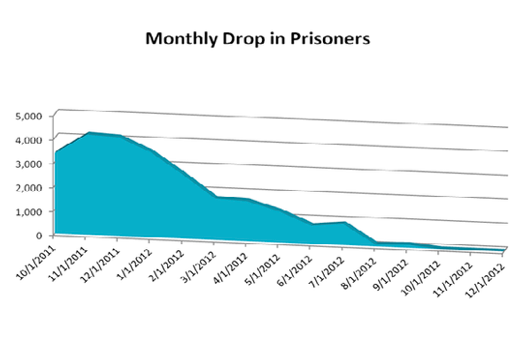
Something unanticipated is happening to the California AB109 Prison Realignment Reform.They have (as hoped) placed some 27,000 ex-prisoners under probation rather than parole supervision and by statute denied the courts and counties the authority to return these offenders to prison without a new serious or violent offense. But of late, the number of prisoners has stopped its substantial monthly reduction, to the point where the drop in state prisoners was a total of seventy-seven in August (see L.A. Times graph).


It’s somewhat unclear why the reduction in prisoners has been reduced to a trickle, but the situation presents serious problems for the state. Califronia is under a Federal Court order to reduce its prison population or face the Federal Court ordering the release of prisoners.

More baffling is the stabilization in the numbers of state prisoners. It is suggested in an article in the Los Angeles Times that it is the result of county judges who decide to send offenders to state prison, rather than keep them local. But judges have limited discretion to send offenders to state prison if the new offense is what is called a triple non (conviction of a non serious, non-violent. non- sex offender).  But those judges who are intent on sending triple nons, (with serious or violent prior convictions) to state prison, often have the discretion to do so. This may be why the prison population is no longer dropping. Clearly, further investigation and analysis is required to understand why realignment has hit a speed bump.


© 2007 -  Reentry Court Solutions. All Rights Reserved.


Reentry Court Solutions Powered by Communications Team