Vision 8: ‘God is a prisoner,’ says pope in call for justice system reform

NOTE: Sept 18,2015…With the Pope visiting the U.S. this week, I think his statements in regard to incarceration and imprisonment are extraordinary and extremely timely as the nation looks at the issues leading to overpopulated prisons.

Pope Francis,in a talk with Italian Prison Chaplains called for a more humane justice system, saying God too was “a prisoner” of the world’s injustices and was in every cell. Rather than write about the Pope’s words, here are his extraordinary words as spoken::

“God is a prisoner too. He is inside the cell,”

He is a prisoner of our egoism, of our systems, of the many injustices… that punish the weak while the big fish swim freely,”

“You have spoken of a justice system for reconciliation, a justice system of hope, of open doors, of new horizons,” he said. “This is no utopia. It can happen,”

“Thinking about this is good for me: When we have the same weakness, why did they fall and I didn’t? This is a mystery that makes me pray and draws me to prisoners,”

“No cell is so isolated that it can keep the Lord out. “He is there. He cries with them, works with them, hopes with them. His paternal and maternal love arrives everywhere.”

“He, too, is imprisoned today, imprisoned in our selfishness, our systems, and many injustices because it’s easy to punish the weakest, but the big fish swim free.”

A New Grand Bargain on Criminal Justice Sentencing

Screen Shot 2013-10-21 at 8.34.53 PMOctober, 21, 2013

I’ve watched the various demographics come together, the political parties spar around it, and religious and community organizations find different purpose through it. It is “Prison Reform” And it means different things to different people with very different agendas. For many its about reducing the number of offenders in prison. How that happens can be less important than getting it done. Others describe it as decriminalization, or legalization of drug offenders or other classes of offenders. Governors often talk about putting offenders into drug courts or other problem-solving courts as a way to reduce drug abuse and criminality.It is hard to understand ho we got to this place where the imprisoned have had their sentences doubled or even tripled  in twenty years, while those sentenced to prison have increased some six hundred percent over the past thirty years. How do we begin to undo the damage we have done over the last generation to our communities.

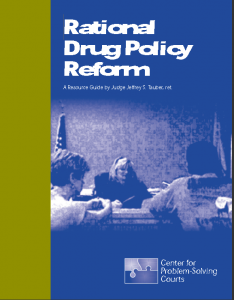
Twelve years ago I wrote a monograph, “Rational Drug Policy Reform”; A Resource Guide (Center for Problem-Solving Courts, 2001). In it, I tried to lay out the arguments for de-criminalization and legalization, in an attempt to show how different the two were, and how important it was for Drug Reform to support hte former and oppose the latter. At the time, it was clear to me those who possessed small quantities of drugs should only be charged with misdemeanors; that demanding felony convictions would destroy far more lives than it would ever save. I described the criminal law as a public health tool or a means to an end, reduction in drug abuse and criminality. Though some of what I wrote didn’t turn out to be especially prescient, I believe the decriminalization of drugs and the reduction of less serious offenses to non-prison offenses has proven to be sound policy.[click on image on left for copy of “Rational Drug Policy Reform”]

So we’re very much in the place we were then. California’s Proposition 36 was a plan to keep drug abusers out of custody,  (pretty much under any circumstance). I wrote my monograph to address the dangers of a law that neither provided incentives or sanctions to the drug offender. Proposition 36 has been forgotten by many, and there is little scientific data to support declaring it a success or failure; an unfortunate circumstance. Today, the Governor has vetoed a bill that would make possession of more serious drugs (cocaine, heroin,……) a felony or misdemeanor, depending on how the D.A. and judge charge/process the offense. Is the Governor right or wrong. He claims that he isn’t opposed to the legislation; only that it ought to be part of a grand criminal justice agreement, that will settle the many criminal justice issues that remain outstanding.

Governor Brown in 1976 reaching a grand Bargain (the Uniform Determinate Sentencing Act) that turned out to be a disaster of the first order. Writing about it’s progeny in the Modesto Bee, “California today has more than 1,000 felony sentencing laws and more than 100 felony sentence enhancements spread across 21 sections in the California Penal Code.” Perhaps we need to move forward toward real criminal justice sentencing reform now, rather than put it off for another day.

Cal allows expungement of some prison felonies

061909Prison3_186762fOctober 14, 2013

As reported by the” Lawyer’s Committee”, co-sponsor with the ACLU among others, of the bill signed by the Governor on October 13.

“As a result of the “Public Safety Realignment Act” of 2011, some individuals will now serve sentences in a local jail for lower-level felony convictions that used to have state prison as the only sentence available. Under AB 651, after these individuals serve their time in jail, they will have an opportunity to ask the court to set aside their convictions, subject to a waiting period and a showing of rehabilitation. AB 651 provides a critical step forward for people who have served their sentences, helping them to avoid the stigma associated with prison time and to better access the jobs and housing they need to leave the criminal justice system permanently behind them.”

I agree with the “Lawyer’s Committee”. AB 651 is an important step forward. It allows felony offenders to seek expungement of less serious felonies, where the offender is sentenced to prison (but under California’s “Realignment Reform” serve their term in county jail). It is estimated that as many as half of offenders sentenced to prison in the future, will serve their term under county jurisdiction and post sentence supervision. That means that those offenders can return to the court to request expungement (as post-felony probationers do now), after they have completed their jail and/or court supervision. The D.A may object as they often do now, and the court may ultimately deny the request,  but the jurisdiction is with the court, as to whether a felon sentenced to prison (yet serving under county jurisdiction), may have their offense expunged by the court.

In all, a very good indicator of the direction of the criminal law, placing jurisdiction and discretion with the court as to  the felony offender’s criminal status,reentering the community.

Governor Brown takes next step in Prison Reform

Screen Shot 2013-10-07 at 3.06.13 PMOctober 9, 2013

Governor Brown has somewhat reluctantly taken an important step forward in prison reform. While just a few short months ago, he was insisting that he had done all he could to improve prison overcrowding consistent with community safety, he has with the passing of two important pieces of legislation still made impressive progress.

As noted  in the Press-Enterprise, on Oct. 5, Governor Brown signed into law the Trust Act, which bars police from turning over immigration detainees arrested for non-violent crimes to federal immigration officials for possible deportation. While the impact upon prisons may not be immediately apparent, the fewer immigrants held in custody either in state or county facilities (or in state or county facilities leased by federal authorities), the less the need for new prisons and jails in the state.

More importantly, Governor Brown signed a bill, a compromise hashed out with State Senate President Daryl Steinberg, that allows for the continuing imprisonment of some 9,000 prisoners (with the agreement of the three judge federal panel), while over $300 million is spent on drug and mental health treatment, and  other alternatives to imprisonment over the next three years.

If the Three Judge Federal Panel had refused to modify it’s previous order to reduce Cal prisons by an additional 9,000 by Decemebr 31, Brown would have sent the 9000 to private or out of state prisons. But the Judges seized upon the opening to  move the state toward a more lasting and “durable solution to the prison crowding problem”, and extended the  prison reduction deadline until Jan. 27 to allow the state to meet with inmate lawyers and said that they might extend the deadline even further if progress is being made.”

Importantly, as noted in a Press Democrat article, “the court also gave some directions, saying discussions about reducing prison crowding should cover juvenile offenders serving lengthy sentences, inmates being held for federal immigration authorities [addressed in the Trust Act], elderly and infirm inmates, and three strike inmates eligible for early release under an initiative approved by voters in 2010”.

All of the above is an important intermediate step in a process to reform California’s prison system. As noted in my article of February 2013, “The easy part of prison reform”, found immediately below, we are just beginning the process of reforming our sentencing and prison system.


The easy part of prison reform

Screen Shot 2013-01-14 at 12.59.00 PMFeb.10, 2013

The following article is reprinted from a February posting, as it speaks to the dilemma that California criminal justice policy makers.

According to the Sacramento Bee, “Gov. Jerry Brown had his “Mission Accomplished” moment…… He believes “victory should be declared” in the state’s prison overcrowding crisis” He was also quoted as saying “California’s prison health care system is now a model for the nation,” and that any further reduction in state prisoners would endanger the public’s safety.

Clearly the Governor has much to be proud of. He had pushed through the legislature, AB109, a bill that reduced prison populations by about 50,000 prisoners in a year, and fought successfully for Proposition 30, making billions of dollars available to counties impacted by Brown’s transitioning of responsibility  for non-violent, non-serious, and non-sex-offenders to the counties. Still, what has been accomplished is the first part, the easy part of prison reform, More complicated and critical reforms have not begun to be addressed.

State prisons still house offenders who could do better in their own communities, even if it means spending additional time in county jail. AB109 was intended to encourage alternatives to incarceration, but relatively few counties are accepting that challenge, Instead most are expanding and/or building new jail facilities. Somehow, we must encourage counties to spend more of their Proposition 30 money on alternatives to prison rather than jail substitutes for prison. One obvious reform would be to encourage judges to sentence AB109 offenders to spit sentences  (offenders who must be housed in jail, even though the offense is defined as a prison offense), so that the court could supervise their jail conduct and rehabilitation in the community. More than 80% of AB109 offenders sentenced to jail receive a jail sentence that cannot be reduced or transferred to community supervision.

While Governor Brown’s prison reform limits those sent to prison to more serious offenders, it ignores the doubling of prison sentences for serious offenders over the past twenty years. Why assume that the legislature’s response to sensational crime with ever increasing penalties is rational or justified. Why assume that the labyrinth of sentencing law and enhancements make sense or are necessary or appropriate.

Then there are the obvious reforms that almost everyone supports, but for some reason are almost never implemented. Drug, alcohol and mental health treatment, education, and job training while the offender is in custody, is almost universally supported by the public. Half-Way Houses or similar Institutions, that allow the offender to transition to the outside, while continuing under custodial or other substantial supervision are also favored by most.  Finally, continued oversight of the offender while in the community, under the care and supervision of the court and supervisory agencies (through AB109 split sentencing or reentry courts) is a necessity for most successful prisoner rehabilitation.

It’s easy to see that the governor has done well in beginning the prison reform process in California. Stopping now, without continuing and expanding its scope, providing resources, assistance, and supervision to those coming out of custody, will surely set the incarcerated up for continued failure and and a return to custody.
 

© 2007 -  Reentry Court Solutions. All Rights Reserved.


Reentry Court Solutions Powered by Communications Team