Urban Institue reports on “Justice Reinvestment Initiative”

Screen Shot 2014-01-28 at 11.32.43 AM January 28, 2014

The Urban Institute has issued a positive report on seventeen states that have adopted the “Justice Reinvestment Initiative”and issued the following statement,

“Seventeen Justice Reinvestment Initiative states are projected to save as much as $4.6 billion through reforms that increase the efficiency of their criminal justice systems. Eight states that had JRI policies in effect for at least one year – Arkansas, Hawaii, Louisiana, Kentucky, New Hampshire, North Carolina, Ohio, and South Carolina – reduced their prison populations. Through the Initiative, states receive federal dollars to assess and improve their criminal justice systems while enhancing public safety. This report chronicles 17 states as they enacted comprehensive criminal justice reforms relying on bipartisan and interbranch collaboration. The studynotes common factors that drove prison growth and costs and documents how each state responded with targeted policies.”

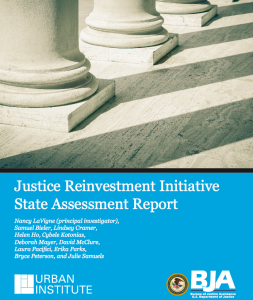
The Justice Reinvestment Initiative State Assessment Report was written by Nancy La Vigne, the project’s principal investigator, along with a team of researchers from the Urban Institute (click on image on left for PDF).

[See Justice Reinvestment Initiative”Leads Prison Reform]


Most of Cal. Realignment funds go to Jail Expansion

January 20,2013

It’s disheartening to see the negligible amount of money that has been made available for rehabilitation and reentry programs under California’s Realignment Reform. Most of the state’s money comes from a discretionary realignment fund that counties can use to fund realignment projects as they see fit.

According to a report last year by the Stanford Criminal Justice Center, criminal justice critics say county leaders could have spent more of their new money on rehabilitation. In the first year of realignment, counties budgeted 16 percent of the $367 million they received from the state for services such as mental health and drug treatmentScreen shot 2012-11-04 at 6.14.22 PM (Sacramento Bee, Jan 14,2013).

“Leaders at the California State Association of Counties, the Chief Probation Officers of California and the California State Sheriffs’ Association say they need more money for job training, mental health care and substance abuse treatment.” But still the state overwhelmingly supports funding jail expansion at the expense of treatment and rehabilitation dollars. California’s new budget proposal plans to give counties $500 million for new jail space, on top of $500 million that is now being distributed through a competitive grant program.

Part of the problem is that the California Department of Corrections and Rehabilitation historically has not emphasized rehabilitation,  Just 5 percent of department spending goes to programs and services for offenders,

And part of the problem is that counties are fearful of the political consequences of crimes committed by offenders serving prison sentences in jail facilities. According to the Sacramento Bee article,” Sixty percent of parolees released to counties from October 2011 through September 2012 were arrested for new offenses within 12 months of leaving prison, the same rate as a comparable population of parolees managed by the state the year before the law took effect.”

There are several promising provisions in the Governors new state budget that may have a substantial impact on those statistics. The budget proposal authorizes  $81 million to go toward re-entry centers, mental health services and drug treatment for offenders.

Most significantly, the Budget  proposal would require that all felony sentences served in county jails be split between jail time and mandatory supervision, unless a judge concludes that a split sentence is not in the interest of justice. That last provision promises to reverse the current trend, where judges across the state are overwhelmingly sentencing felons to county jail  under AB109 for straight time (straight time may not include “mandatory supervision, basically community based supervision or probation).

Until the counties meet their responsibility to provide substantial rehabilitation resources and monitoring for prisoners released from jail under P.C. AB109, we are unlikely to see significant benefits from the transfer of felons from state prisons to county jails.

Brown’s Budget makes good on Reform Mandate (mostly)

Screen Shot 2013-10-07 at 3.06.13 PMJanuary 6, 2013

Gov. Jerry Brown’s budget for the coming fiscal year includes several proposals welcomed by reformers. They are also intended to help the state comply with a federal court order requiring the reduction of prison overcrowding by mid-April to improve medical and mental health care for inmates.

According to the Sacramento Bee, the budget package:

—allows for the parole of medically incapacitated inmates; considering parole for inmates age 60 or older who have served at least 25 years in prison; and increasing good-time credits for non-violent second-strike offenders

— Frees up $81 million for rehabilitation programs that otherwise would be spent to house inmates, if the federal judges grant the two-year extension to meet a court-ordered prison population cap.

— Spends $8.3 million to redesign the 600-bed Northern California Reentry Facility in Stockton, although it will take more than two years to ready the facility to house male inmates.

— Adds $14 million to fight the smuggling of drugs and other contraband, including cellphones.

— Allocates nearly $65 million for the Department of State Hospitals to help the agency deal with a more violent mentally ill population that increasingly comes from the criminal justice system. A U.S. District judge last year ordered increased federal oversight after finding problems with the department’s treatment of mentally ill inmates.

— Gives counties $500 million for new jail space, on top of $500 million that is now being distributed through a competitive grant program. The proposal requires that counties demonstrate they are taking steps to lower their jail populations by freeing more suspects who are awaiting trial.

— Inmates sentenced to more than 10 years in county jails under the state’s two-year-old criminal justice realignment law would again serve their time in state prisons. That would increase theprison population by a projected 300 inmates, felons that sheriffs have said they are not equipped to handle. The shift would come only if the state is able to comply with federal judges’ prison crowding reduction order.

— Reduces the cost to counties to send local inmates to state-run firefighting camps. Counties have said the current $46 daily rate is too costly. Counties would pay $10 a day for each inmate at a firefighting camp, and $81 each day the inmates are being trained.

— Requires that all felony sentences served in county jails be split between jail time and mandatory supervision, unless a judge concludes that a split sentence is not in the interest of justice.

That last item is extraordinarily important. Though Courts have had the power to split sentences under “Realignment” they overwhelmingly have declined to do so. If passed, this provision will create a right to a split sentence (unless the court makes a special finding), which will require the courts to grant “mandatory supervision” to less serious prisoners housed in county jails, releasing offenders into the community under the supervision of Probation and optimally involving them in rehabilitation programs that will help reintegrate them into the community.

Not all of these provisions can be considered reforms (the provision allowing counties to shift prisoners from county jail to prison when a sentence is more than ten years is of particular concern), but they are an important step in the right direction, including many provisions that reformers have sought since Realignment was announced in 2011.

Holding Steady in the New Year

Screen Shot 2014-01-05 at 11.26.21 PMJanuary 6, 2014

Reading the articles, studies, and editorials over the past few month can bring on an attack of schizophrenia. Different news sources review the same studies regarding sentencing and prison reform and come to completely different conclusions. It’s interesting to track the stories as they have played out in the media. What started out  last year as widespread over the top endorsements of prison and sentencing reform  has morphed into a mixed bag of modest optimism and panicked defeatism.

I think I  have an idea of what’s going on. The reforms that are playing out across the country are having some success, but not the extraordinary early success predicted by some. That allows the more reactionary elements (especially those financially tied to  existing incarceration models), to redouble their efforts to undermine reform efforts.

The expectation is that releasing an offender into the streets should result in immediate rehabilitation . Well it doesn’t work that way. It takes sustained and systemic effort to get folks to change their ways. Consider, can we really expect those released with no resources, skills, family, jobs and/or education and often without housing or sustenance, to change on their own. It defies logic to expect that, but that is what those attacking sentencing and prison reform are arguing should happen.

In California, in particular, Prison Realignment, the historic reform being implemented, moves less serious offenders out of prison into county jurisdiction (meaning county jail for many). Recently it has come under attack as precipitating a “crime wave”, both in our communities and in our jails.

We’ve heard how jail violence has increased in California and how it must be inextricably linked to the violent offenders held in jail rather than prison. At the same time the critics seem to ignore the fact hat violence in prison is substantially down as well (see: Cal Jails see increased violence since Realignment)

We hear about the latest  news reports on those released under realignment from 2011 through 2012 and read how their has been an uptick in California crime which must be the result of realignment. However, if you read the actual report by  Magnus Lofstrom  and Steven Raphael of the Public Policy Institute of California, “Public Safety Realignment and Crime Rates in California” [click on image on left for PDF], you come away with little reason for panic. It should concern us, that the lack of structured reentry systems  in much of California is a problem, and one sufficient to cause  reassessment  and modification of the existing  sentencing systems.

For example, while there is little evidence of any increase in violence there is substantial evidence of a small increase in property crime, in particular car theft. We also know that there are 18,000 fewer offenders in custody (27,000 fewer in prison minus 9,000 additional in our jails). It stands to reason that we need to modify how we deal with the non-violent property offender, including the use of the funds we are saving (by not locking up 18000 prisoners), to provide resources and assistance as well as increased monitoring where appropriate. None of these changes come easy, but there is excellent reason to believe they are slowly working themselves out, if you manage to hold steady in the new year.

© 2007 -  Reentry Court Solutions. All Rights Reserved.


Reentry Court Solutions Powered by Communications Team