No. 8 in a Series: Finding Success in the English Based Court Systems

July 28, 2014


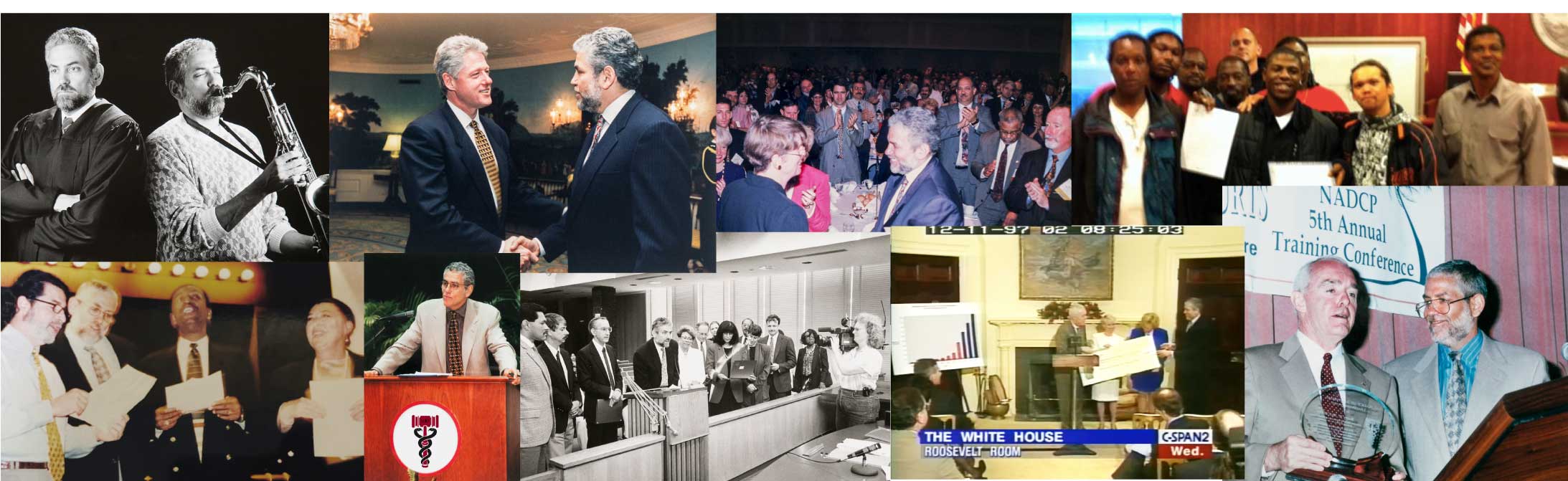
As the newly elected President of NADCP, I presented at  the United Nations Headquarters as well as the U.N. Headquarters in N.Y.C. and the Vienna Campus on several occasions in the 1990’s (publishing a paper on the development of International Drug Courts, “American Drug Courts: A Common Sense Approach to the Drug-using Offender” distributed by my U.N. hosts).  I had the good fortune to be invited to a Conference in New Delhi, where U.N. policy was to be drafted for the year 2000 “United Nations Conference on the Global Drug problem”. Though the drafting of the resolution was difficult (and even undemocratic), it ultimately included a section in the policy statement approving court-ordered treatment as an alternative to incarceration (including drug courts).

In 1998, I was asked to assist in the formation of Drug Courts in the Pacific region. I flew to Guam to make a series of presentations to Asian and Pacific Islander criminal justice leaders at a Conference on Drug Abuse, and met with judges who were considering the development of local drug court models. After visiting Guam, I continued on to Australia, where I spent a week meeting with officials from relevant criminal justice and public health agencies, (including the New South Wales Prime Minister and his Cabinet). I can say that the Australians picked up on the drug court idea quickly and instituted drug courts with remarkable speed and effectiveness.

What was in many ways unique about the Australian approach to Drug Courts was their extraordinary collaborative approach and their understanding of the drug court’s role as an adjunct or tool of the  public  health  system in dealing with drug  addicted offenders charged with serious criminal offenses. There was little reluctance to engage heroin  addicted  home burglars in the Sydney Drug Court nor to see the process as mainly a therapeutic rather than a punitive system (something we still struggle with in the U.S.).

The New South Wales Drug Court Act of 1998, was  passed shortly after my initial trip to Australia, and  the Sydney Drug Court was the first drug court of its type initiated in Australia. When I returned for further consultations and a conference in Western Australia the following year, I found a thriving drug court in Sydney, working with the high risk offenders that drug courts are designed for. The Australians were so pleased with their drug court, that other drug courts were already being planned. It has occurred to me that the Australian criminal justice system was as successful as it was because the Australians shared a common english criminal justice tradition, a similar western culture, and the technical, treatment and rehabilitation resources required by an American Drug Court, (something we would not see in many other Asian nations).

…………………………………………………………………

 

No. 7 : Accomplishing Drug Court Reform without Drug Courts

July 25, 2014

My interest in crime and punishment began early in my career. After graduating from Boston University Law School in 1971, I spent 16 months traveling around the world, visiting over 40 nations. My travels weren’t focused on criminal justice issues, but I found myself drawn to how different cultures dealt with social deviation. In 1988, before taking the bench as a judge, I spent four months in the South Pacific; this time visiting courtrooms, judges, jails and prisons, focusing on how Polynesian and Maori cultures dealt with criminal conduct.

In the 1990’s, one of my priorities as NADCP’s founding President, was to see that the nascent drug court field did not collapse into a more punitive and destructive system than that which had existed before. At the time I was painfully aware of the shortcoming of some of our drug courts. Jurisdictions created drug courts for small numbers of offenders, with minimal or nonexistent drug dependence, and an over-reliance on non-therapeutic custodial sanctions. It was a direction that I strongly opposed and NADCP made a major effort to counter (and did so successfully in 1997 with the publication of “Defining Drug Courts: Key Components”)

These issues were unfortunately magnified at the international level. While the drug court model was adopted successfully in westernized nations based on the english legal system (specifically Canada and Australia), the idea that they could be easily adopted in traditional, third world countries was a somewhat fanciful notion. International Drug Courts provided a level of prestige for the U.S. model (especially before the Congress and state legislatures), but didn’t catch on in a significant way in non-westernized nations. Societies that didn’t have treatment programs, trained clinicians, drug-testing, or probation systems, let alone decent housing or clean water, would have a hard time replicating an American drug court model.

Though I traveled widely in the 1990’s on behalf of NADCP and Drug Courts across the globe, it was with some skepticism about expanding drug courts internationally and an emphasis on what other cultures could devise that would accomplish the goals of drug courts, without actually adopting the model itself.

…………………………………………………………………


No. 6 : “The Prison that Shuts Down for the Weekend”

July 14, 2014

Samoa provided one of those comedic moments that are rare in the world of criminal law. I visited a prison seemingly built into the side of  a mountain. Huge cauldrons (the kind that they cook tourists in on T.V.) were being stirred. The prisoners were in cells that resembled caves, while the weather was unbearably hot and humid.

I asked the prison commander about the almost inhuman conditions and he replied in a friendly manner, that the prison guards basically close the prison down over the weekend and everyone, including serious prisoners, go home to return the following Monday to continue their prison terms. I found that explanation to be a wonderful insight into another culture’s approach to incarceration. The Samoan Islands prison system reminded me of the song, “Hotel California” by the legendary country rock band, the “Eagles”. They sang,”you can check out anytime you like… but you can never leave”.

At that point in time, offenders charged with an offenses had little opportunity to escape nor much impetus to do so. They were fully part of their Samoan Family and Village Culture, and would find it almost impossible to leave their homes to seek sanctuary anywhere else.Their’s was a  sense of belonging, as well as isolation from the rest of the world, that prevented the Samoan prisoner from leaving the Island.

P.S…..For years I enjoyed telling that story as an example of how different punishment can be in different cultures. That is until I read a recent story in the newspapers about how Samoa had been cited by FreedomWorks as a nation whose prisons violated the basic human rights of prisoners. To this day, I’m inclined to believe the Prison Warden’s narrative of the “Prison that shut down on Weekends”.

…………………………………………………………………


No. 5: Village Based Restorative Justice; Ifoga

July,6, 2014

I went to several courts in Fiji, Western Somoa (Somoa today) and Tonga. All had foreign magistrates (to the best of my recollection, New Zealanders), who presided over their courts at the time. I remember thinking that using foreign judges or even judges from the next village was a problem where communites were so insular, and conflicts so localized that they needed community based solutions.

I had read about the custom among the Polynesians that involved a wrongdoer’s family making amends to the victim and the victim’s family by bringing food and gifts to the  family as informal family based justice, called Ifoga. It was understood that the offender’s family would take whatever measures were necessary to control the offender in the future. I was told that a family would literally camp on the neighbor’s steps until they would accept the proposed restitution. A wonderful concept and one that makes sense when the malfeasor is known and the damages relatively minor.

I was in a Somoan Court when the New Zealand magistrate was asked to accept this form of restituion in the case before him. He rejected the offer out of hand, and I cannot say I disagreed with him. The defendant had thrown a rock at a girl and blinded her in one eye. Something more than restituion was clearly called for. But the idea of bringing peace to the community by making restitution and even more importantly relying on the family itself to control the miscreant had an authentic ring to it.

…………………………………………………………………


© 2007 -  Reentry Court Solutions. All Rights Reserved.


Reentry Court Solutions Powered by Communications Team