Penn Prison Chief tells it like it is

Screen Shot 2014-02-26 at 12.13.53 PMFebruary 26, 2014

Political leaders across the nation should take note of Pennsylvania’s Corrections Secretary John Wetzel, a straight talker who is willing to tell it like it is.

Responding to legislators concerned about increased numbers of Pensylvania prisoners, the following is a summary of his testimony before the House Appropriations Committee on February 12, is reported in the Patriot News (he best speaks for himself).

“You say you want change, but you keep passing the same bills,” Wetzel told the lawmakers.

Since adopting the prison reform legislation aimed at reducing the prison population, he said, the House has passed no fewer than 23 bills that will likely increase it – either through the creation of new criminal offenses, or lengthening the sentences for existing crimes. No one bill could break the reform, but the small impact of multiple bills combine to a formidable threat. Wetzel called it “death by a thousand paper cuts.”

” Wetzel said every budget season he goes to the Capitol to explain corrections policy to lawmakers, “and then they forget about it until the next year.” Correctional Policy, Wetzel said, should have two goals: the response should be equal to the crime and the response should yield results; in other words, the offender should be less likely to commit another crime when he exits the criminal justice system”

. “You can’t say that about some of our current laws and corrections policies,” said Wetzel. He said, “No less than 23 bills have passed the House, every one of which has the potential to increase prison populations,” but legislators have done little to counteract the effect of those legislative efforts through legislation aimed at reducing crime and prolonged incarceration.”

I think we should to keep an eye out for further comments from Corrections Secretary Wetzel.

.



Screen Shot 2014-02-18 at 7.31.28 PM


February 17, 2014

The federal Government has recently doubled down on their investment in drug courts. What was once a  $6 million federal program has grown to a major government project amounting to approximately one hundred million dollars.

As described in the Grant Publication,”The goal of the Adult Drug Court Discretionary Grant Program is to build and/or expand drug court capacity at the state, local and tribal levels to reduce crime and substance abuse among high-risk, high need offenders. States, Local courts, Counties, Units of local government, and Indian tribal nations are eligible for 60 grants.

States that are looking to improve, expand or enhance drug court services statewide and/or financially support drug courts in local jurisdictions  are eligible for grants of up to $1.5 million over a three year period.

While not directly aimed at court-focused prison reform, it would not be difficult to design a grant project that would use its resources on offenders who were otherwise heading for prison. State agencies should take a long look at the money available under this and other federal programs, that can be used to reduce prison populations, drug abuse, and criminality in their communities.

“States applying for funding under this subcategory must demonstrate a statewide, data-driven strategy for reaching and expanding capacity of drug court options and services for nonviolent substance-abusing offenders, which may include: implementing new drug courts; reaching capacity of existing drug courts; and expanding/enhancing capacity of existing drug courts to reach specific or emerging offender populations with drug treatment needs. The support provided through such statewide awards must also be consistent with the evidence-based principles outlined above” (Drug Court Funding)

 All applications are due by 11:59 p.m. eastern time on March 18, 2014. 


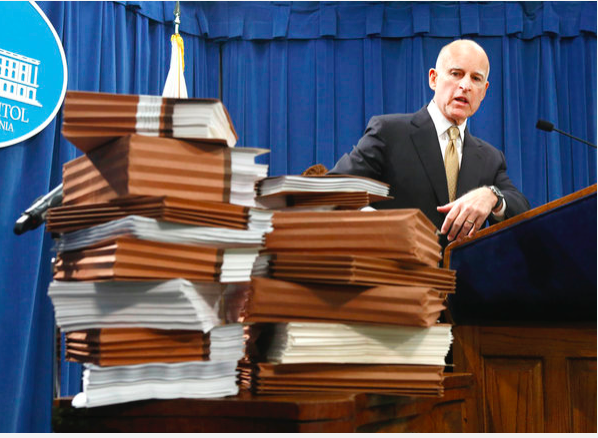
Brown gets 2 year extension to reduce prison pop.

Screen Shot 2014-02-13 at 7.10.05 AMFebruary 17, 2014

A three judge Federal Panel that has been demanding the reduction in  California prison overcrowding has decided to give Governor Brown one last opportunity to reduce prison overcrowding under  a new state plan.

The order from the three-judge panel delayed an April deadline to reduce the prison population to about 112,000 inmates. California remains more than 5,000 inmates over a limit set by the courts, even though the state has reduced its prison population by 25,000 by shifting less serious prisoners to county jails over the last two years

Seen as a major win for Brown and the democratic legislature,  Monday’s order instructed the state to immediately carry out a series of measures to either release or move inmates from state prisons. These include: increase credits for nonviolent second-strike offenders and minimum custody inmates; set earlier parole eligibility for some nonviolent offenders; ease parole for inmates who are older than 60 and have already served at least 25 years in prison; and expand alternative custody programs for female inmates.

The judges also backed a state proposal to appoint a compliance officer to ensure California is on track to comply with the inmate population cap.As part of the order, the court barred prison officials from exceeding the current 8,900 inmates in out-of-state prisons, limiting a tactic the Brown administration has used to lessen overcrowding in California’s prisons.

In a statement, Brown called the order “encouraging.”

“The state now has the time and resources necessary to help inmates become productive members of society and make our communities safer,” the governor said. Brown has committed the state to spend $80 million over the next two year on rehabilitation and reentry programs that will increase the number of successful reentries into society.


AG Holder’s push for systemic clemency program

Screen Shot 2013-11-12 at 8.51.44 AMFebruary 3,2014

The Washington Pst reports that the  Obama administration is stepping up its efforts to overhaul the criminal justice system, called Thursday for the early release of more low-level, nonviolent drug offenders from federal prisons.

“Deputy Attorney General James M. Cole, speaking to the New York State Bar Association’s Criminal Justice Section, said the administration wants to free inmates who no longer pose a threat to public safety and whose long-term incarceration “harms our criminal justice system.” He appealed to defense lawyers to identify candidates for clemency”.

© 2007 -  Reentry Court Solutions. All Rights Reserved.


Reentry Court Solutions Powered by Communications Team