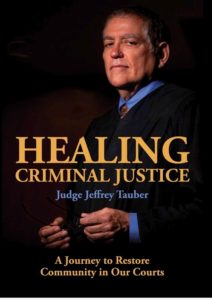
HEALING CRIMINAL JUSTICE: A Journey to Restore Community in Our Courts (free download through 2020)

Healing Criminal Justice: a journey to Restore Community in Our Courts, is  newly published , by Judge Jeffrey Tauber (free download on Amazon through 2020). It’s central theme is the rediscovery of the healing power of community within the criminal justice system. Judge Tauber lays out his vision of a future, in which society, recoiling from its overreliance on imprisonment,  returns to its historic use of community to control criminal behavior.

Healing Criminal Justice also speaks to how leadership from within can change the trajectory of a major institution, even one as immovable as the criminal justice system.

Finally, ”Healing Criminal Justice”  celebrates the 25th Anniversary of the National Association of Drug Court Professionals (NADCP). Written by its founding president and president emeritus, it describes NADCP’s path to nationwide champion of criminal justice drug reform.

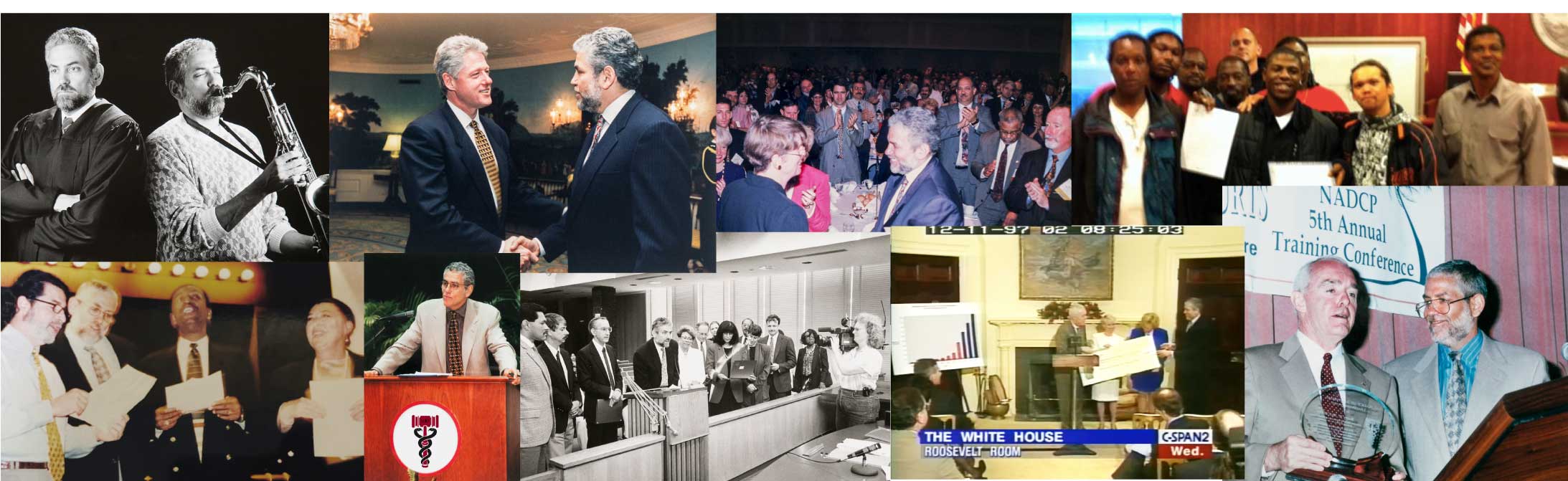
In Healing Criminal Justice, Judge Tauber describes his  experience as one of the nation’s first drug court judges and how a nascent field with a few scattered programs was transformed into a nationwide movement. He recalls his worldwide travels as well as his experience as a struggling saxman playing in Oakland’s blues clubs, and how both contributed to his understanding of one of the most vital elements in the criminal justice system: community.

Judge Jeffrey Tauber (ret.) is the Director/Editor of Reentry Court Solutions (RCS), an educational initiative that provides a nation-wide information website; as well as technical assistance, training, and advisory services to the field.

To access an excerpt of the book, please click on the link on the right: hhtp://healingcriminaljustice.com


profile of the author as a world travelling sax playing judge

Two narratives on promoting your book: They told me I needed to stay focused.  I actually thought that all you had to do was find the thousands of  hours to write your book. If you have something to say that’s worth the read, then people will read your book. Of course when I put that idea out there to the professionals, they laughed.

JJJ Press
[Jazzy Judge Jeff]
“From the blues and jazz clubs of Oakland, to the prisons of Fiji and Samoa, to the halls of Congress and the White House, Judge Jeffrey Tauber recounts his ascent to the leadership of the nation’s drug and problem-solving court movement.

“It’s  also about the challenges one faces when you try to do something really big; when you challenge an entire government bureaucracy. How you run into  buzzsaws coming from every direction. How you need to be willing to sacrifice nearly everything you care about. You have to be driven, and lucky, and you’ve got to catch that big wave just righ, to make it happen. And even after all that, it may not be worth the fight.

In this case, maybe it was. Over three thousand drug and problem-solving courts established over the past twenty-five years; over a quarter million persons trained and educated in alternative treatment practices and principles; Over one and a half million participants entering drug courts since 1994 when NADCP was formed..

In wistful and humorous anecdotes, he recounts his worldwide travels as well as his experience as a struggling saxman playing Oakland’s clubs, and how both contributed to his understanding of the most vital element in the criminal justice system: community.”

Healing Criminal Justice’s central theme is the rediscovery of the healing power of community. Judge Tauber lays out his vision of a future, in which society, recoiling from its overindulgence in imprisonment,  returns to its historic reliance on community as the controller of criminal behavior.

“Jeffrey Tauber has been a criminal defense attorney and a judge. He has also been a world traveler with a sociologist’s eye and the sensibilities of a musician. In Healing Criminal Justice, Judge Tauber recalls his time on the Oakland bench as one of the nation’s first drug court judges and how he helped transform a nascent field with a few scattered programs into a nationwide movement.

”Healing Criminal Justice” celebrates the 25th Anniversary of the National Association of Drug Court Professionals (NADCP). Written by its founding president and president emeritus, it describes NADCP’s path to nationwide champion of criminal justice drug reform.

Judge Jeffrey Tauber (ret.) is the Director/Editor of Reentry Court Solutions (RCS), an educational initiative that provides a nation-wide information website; as well as technical assistance, training, and advisory services to the field. hhtp://rentrycourtsolutions.com

THE DANGERS OF EXPORTING PRISONS

the Commissioner-General of the Namibian Correctional Service, Raphael Tuhafeni Hamunyela

As bad as overcrowded prisons are in the U.S. and Europe,  the issue of  mass incarceration is hardly limited to the West. It has for too long been an unacknowledged side effect of the westernization of the world. Regions of the world that have little experience with imprisonment have embraced it wholeheartedly, sparking a horendous human rights problem in the developing world. It’s former reliance on community to control its own, has devolved into an unhealthy  acceptance of imprisonment as the solution to criminality. The extent of this problem can be gleaned from an article in New Era Live, a southern africa publication, 

“In Malawi – one of the countries with among the highest levels of congestion in correctional facilities in the world – overcrowding has been put down to a phenomenon in which people who have committed minor offences are sent to jail instead of being sentenced to community service.

Things got to a head in 2006 when the country’s Constitutional Court declared that the extent of overcrowding in some correctional facilities amounted to cruel, inhuman and degrading treatment. The top court urged the government of Malawi to take concrete steps to reduce the overcrowding by half and improve ventilation and prison conditions in general.

Now, the United Nations Office on Drugs and Crime (UNODC) and the Malawi Prisons Inspectorate will this June support training of magistrates in different parts of the country on the use of alternatives to imprisonment when dealing with people who overstep legal boundaries.

This is in line with the United Nations Standard Minimum Rules for Non-custodial Measures of 1990, commonly known as The Tokyo Rules which promote greater community involvement in the administration of criminal justice and in the treatment of offenders. Additionally, they promote a sense of responsibility towards society among offenders.”

If one reads between the lines, it is apparent that Malawi is sufferring from mass incarceration as is the U.S. and the rest of the world. One needs to address this issue as a worldwide problem and not just one impacting the West.

THE RIP VAN WINKLE EFFECT

I began to write a book on my experiences as a drug and reeentry court judge five years ago. At the time I was well aware  of the momentum building for prison and sentencing reform and wrote about it often.

About two years ago I  retired as a  judge. It was my opprotunity to put my head down and get serious about finishing my book before 2019, the twenty-fifth anniversary of the National Association of Drug Court Professionals (NADCP). I was NADCP’s founding President  and wanted to finish the book for NADCP’s annual conference, to be held July 14th thorugh the 17th 2019.

The last two year have been a  blur. Writing, rewriting, fact-checking, researching, all at the same time. Definitely one of the hardest things I’ve ever done.  Constantly dealing with emergencies as you work toward publication.

Hopefully the book will be worth the read. The book is called Healing Criminal Justice : A Journey to Restore Communtiy in Our courts. It is a paen to “Community in our Courts”;  the power of community to control criminal behavior.

One result of writing a book. Over the past two years I’ve been on hiatus from my website, Reentry Court Solutions. I have spent the last dozen years as its main contributor, editor, researcher, manager, director, etc. It is been a very intensive effort at educating the public about the need for reentry courts and other problem-solving courts, as well as reform to our sentencing and prison systems. I was publishing on average an article a week on critical issues. Not an easy thing to do, but it had the effect of forcing me to review dozens of articles a week on reentry, prison, and other criminal justice reform issues.

If I were to do the same today, I would have to review hundreds of articles a week on the same subjects. The attention, concern, and demands  being made on the system by criminal justice reformers is extraordinary, And it is welcome. I feel like Rip Van Winkle who slept for twenty years, though my hiatus was only for two. The point is,  that we truely seem to be woke and it is inspirational. We can and must do as much as we can to stop the demand to punish and  to imprison for increasingly longer terms. It feels like we’ve turned this train around, but the really hard part is just coming up around the next bend; keeping our foot on the accelerator.

© 2007 -  Reentry Court Solutions. All Rights Reserved.


Reentry Court Solutions Powered by Communications Team