Justice Reinvestment Initiative leads Prison Reform

The Best Of: The following article, first published on May 14, 2012, describes the critical role the “Justice Reinvestment Initiative”, led by the PEW Center for the States and the Council of State Governments, have had on the prison reform movement.

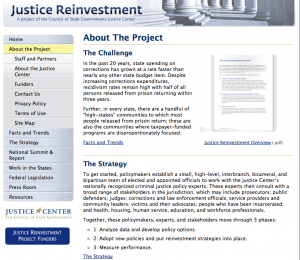
A recent Bureau of Justice Assistance (BJA) funded initiative is having an extraordinary effect on prison reform efforts in states across the nation. The “Justice Reinvestment Initiative” is a joint project of the PEW Center for the States, the Council of State Governmant and the Vera Institute They are providing assistance and support to states in an effort to reduce prison populations,  establish non-prison penalties for non-violent offenses, increase good time/work time for prisoners, and generally encouraging states to return or keep prisoners in local jurisdictions, while reinvesting funds saved by these reforms in “alternatives to prison”. The Council of State Government’s National Reentry Resource Center has a Resource Project Page devoted to the  “Justice Reinvestment Initiative” To access it, click on the page facsimile on the left.

According to information provided by BJA, “Justice Reinvestment is a data-driven approach to reduce corrections spending and re-direct savings to other criminal justice strategies that decrease crime and strengthen neighborhoods. They work closely with state and local policymakers to help design policies that manage the growth of the corrections system. They are finding ways to improve the availability of services, such as housing, substance abuse treatment, employment training, and positive social and family support for offenders returning to communities. They are also looking to reinvest savings generated from reductions in corrections spending to make communities safer, stronger, and healthier.”

What is incontrovertable, is that states are adopting the policy changes advocated and are passing ground-breaking reforms in many of the most conservative states in the nation (most recently Georgia, Oaklahoma, and Louisians; see articles in Facebook collumn on the right side of website).  To access comprehensive information on what the “Justice Reinvestment Initiative” is doing in a listed state, just click on the state below, and you will be linked directly to National Reentry Resource Center information:

California Realignment: Will the Courts help create Balance?

The Best Of: The following article. published on April 15, 2012, describes the critical part the court can play in the development of balanced  sentencing plans under California’a AB109 Realignment Reform.

Reading dozens of articles over the past six months on how California’s AB109 Realignment is being implemented is not for the faint of heart (see Facebook collumn on right for exemplars). An ACLU report complains that counties that historically sent the highest percentage of offenders to prison are being rewarded with extra resources to jail those returning, and additional funds to build or expand existing jails( click here for Mercury News Article on ACLU Report). Prosecutors, Sheriffs, and law enforcement in general decry the very  existence of AB109; that non-violent offenders can be returned to the community without a terrible price being paid by law-abiding citizens (click for Law Enforcement concerns in Butte County). Probation offices and non-profit organizations (including community based agencies and religious institutions) generally favor giving individual offenders opportunities to engage in community based alternatives to incarceration( click here for article on Monterey County’s community-based initiatives).   And so in community after community, county after county, they fight it out, generally law enforcement against probation and non-profit community organizations, with the court often often an uninvolved, yet interested observer.

The courts have an unprecedented opportunity to impact their community’s quality of life. We have operated in a somewhat dysfunctional system, that weighed heavily toward sending offenders to prison. We now have a chance to help create a more balanced  and  reasoned approach to sentencing and incarceration. One way to accomplish this will be to develop more effective “Special Sentencing Courts” (see “Systemic Approaches to Sentencing”), that make better sentencing, probation, and custody decisions, based on validated risk/needs assessment tools (and other evidence based sentencing practices).  More importantly, the courts needs to get involved in their county’s realignment plan, by using their prestige and influence, to help establish a balanced community-wide approach to realignment.  Problem-Solving/Collaborative Courts have shown communities that the courts can make a difference, by providing the vision and leadership for important criminal justice reforms. And so it can be with Sentencing Courts and Realignment.

Success will depend on the degree of cooperation and accomodation individual communities are capable of. Once again the court can weigh in on the side of a rational, reasoned approach. Success in the end may start and end with a community’s willingness to provide the returning offender with job, education, and housing opportunites, as well as rehabilitation programs that have scientifically proven themselves. Jailers and probation staff will need to rely on evidence-based risk/needs assessments to determine who really needs to return to jail, and who can be supervised and rehabilitated in the community.  And the courts need to provide a sentencing system worthy of the community’s balanced realignment plan.  It’s being attempted in a number of counties, and one can only wish them well. And hope that other communities will learn from their example (click here for article on San Diego Realignment Plan).

PEW: The First Survey on Recidivism

THE BEST OF: This article, published on May 2, 2012, describes a PEW document from April 2011, that provides the data necessary for a comprehensive review of state prison systems. (click on the image on the left for a PDF of that document)

The PEW Center on the States  recently released the first ever study on  prison recidivism among the states. Released on April 13, 2011, “State of Recidivism: The Revolving Door of America’s Prisons”, provides  state-by-state data on the rate that people return to prison. Nationally, the survey found that four in ten persons return to state prison within three years of their release.

Early Conservative Support for Drug Courts

June 11, 2013

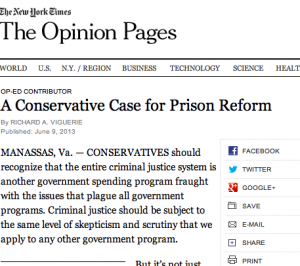
Screen Shot 2013-06-11 at 11.00.53 AMRichard A. Viguerie, a leading conservative figure, argues for Prison Reform, in an OP ED piece in the New York Times  (click on image on the left for article). He argues that “Conservatives known for being tough on crime should now be equally tough on failed, too-expensive criminal programs. They should demand more cost-effective approaches that enhance public safety and the well-being of all Americans”.

While it’s wonderful that the conservative movement appears to support Prison and Sentencing Reform, the law enforcement community and its conservative allies provided key support for alternatives to prison (read: Drug Court)  as early as the mid 90’s.

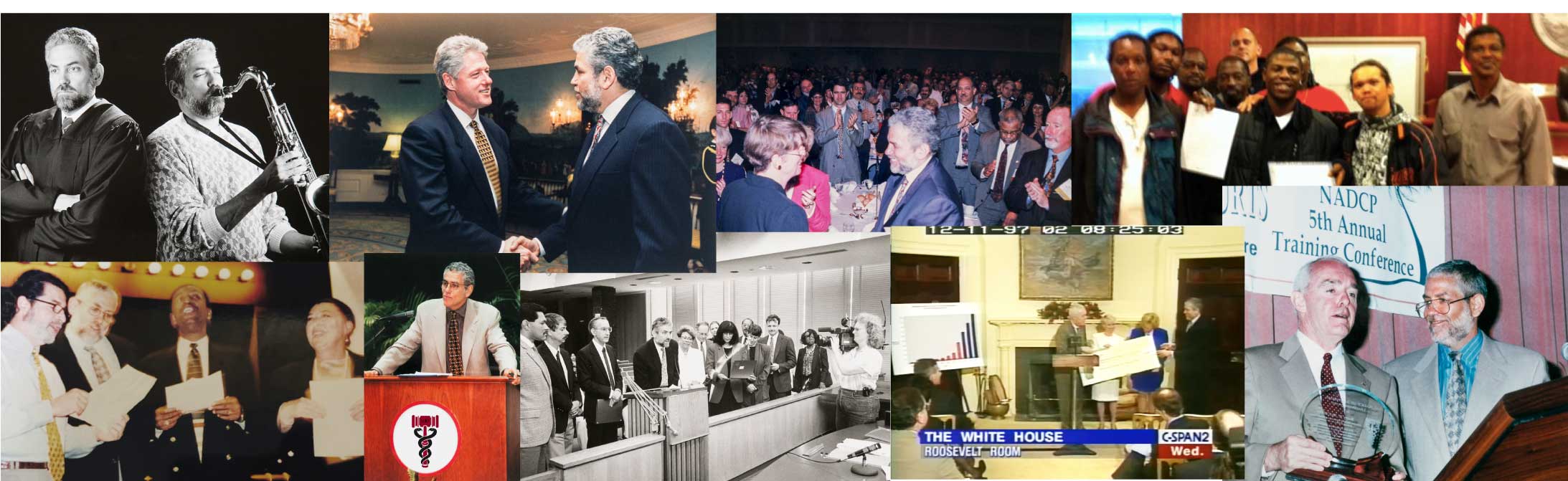
I had the opportunity to observe this phenomenum up close. While I found limited local law enforcement and conservative support for Drug Court in the early 1990’s, the environment began to change by 1994. When I returned to D.C., as the President of the newly formed National Association of Drug Court Professionals (NADCP), the political climate had changed, but not necessarily for the better.

The Republican party had taken over the Congress in 1994, and it wasn’t clear that funding for drug courts written into the budget by the Clinton administration would survive. It would take support for drug courts from key republican committee chairs and  members, to fund the nascent drug courts. This could be described as  a critical point in the drug court movement’s development, when this new innovation could have easily faltered without adequate funding.

I saw my job, as NADCP’s President, to encourage and provide support to drug court judges, D.A.s and others who were willing to visit their Congressional members, both in D.C. and at home. It was their job to convince those Congressional leaders that drug courts worked and deserved federal funding. I contacted Drug Court judges from key states with Republican Chairs or influential congressmen, I encouraged drug court judges to visit D.C.and meet with  congressional members, and I made sure that visiting judges had talking points and other information to rely on in private conversations.  I had no idea how successful a strategy that was to be.

It turned out that the judges (especially) liked to work the halls of congress and were more than willing to move to the fore in supporting drug court funding and visiting with their members of Congress. Many a judge went to school or belonged to the same social circle or clubs as our state and congressional  leaders. Drug Court Judges invited their congressmen and local political leaders to visit their drug court (preferably at a graduation, when they would be given the opportunity to speak at the ceremony, before the media).  Many of the important Committee Chairs had drug courts and drug court judges from their jurisdictions advocating for drug court funding. And it didn’t matter much whether they were democrat or republican, liberal or conservative.

While many a new program died that political season, drug courts received there first ever federal funding from a Republican controlled Congress.


Byrne Grant Funding; Then and Now

June 3, 2013

circa 1990“The Justice for All Reauthorization Act of 2013” (further described in the Facebook article on the right), would, if enacted, require localities to include representatives of a number of different professions, besides traditional police and custodial agencies,  in distributing the largest federal grant earmarked for public safety, known as Byrne JAG grants. As part of the Omnibus Crime Control and Safe Streets Act, Byrne Jag grants provide funds to state and local governments for criminal justice purposes.

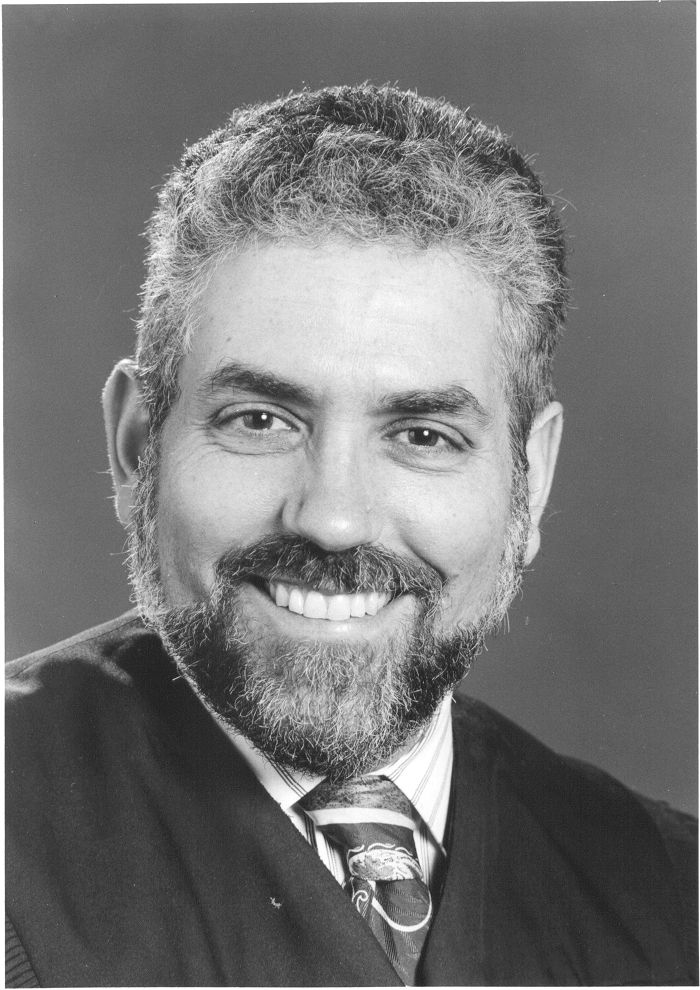
Byrne Grants have been around for a long time. As an example of how important these funding streams can be to nascent (and even an established specialty court program), I will describe my personal experiences with the state-wide California Criminal Justice Task Force, tasked with distributing Byrne grants statewide (on the left, a much younger me; circa 1991)

In 1991, I was casting about for funds to support the nascent Oakland drug court. I learned that the federal government distributed hundreds of millions of dollars to California through Byrne grants, and that rehabilitation and treatment of criminal offenders came under one of the discretionary purposes of the Act. I also learned that both local and state wide law enforcement were  committed to keeping the funding for themselves. I began to attend yearly hearings held by the statewide Criminal Justice Task Force to request that drug courts be funded. At that time, the Task Force was made up almost entirely of law enforcement professionals The first time I stood to speak at a hearing held in Oakland, I got a puzzled look from the members of the Task Force. But I went back the next year and the next, and encouraged others to speak for drug courts at similar hearings held around the state.

Finally, the Director of the Governor’s Office of Criminal Justice Planning (OCJP), who also chaired the Criminal Justice Task Force nominated me to be a Task Force member (perhaps as a means of keeping me away from the podium). At that time, few, except those in law enforcement seemed to know  when or where the meetings were to be held (although I am sure the official notices of the meeting could be found in some obscure publication). I sent my own notices to those who supported drug court: judges, legislators, county officials, criminal justice and treatment professionals, and many who were interested in starting a drug court in their jurisdiction.

As you can imagine, there was a flood of speakers over the next several years appearing and speaking out for drug courts. As a matter of fact, I would venture to say that at least half of the speakers attending meetings while I was on the Task Force, were there to support drug courts. What followed was a $500,000 grant to statewide drug courts in 1995 and two  one million dollars grants to follow.  When I returned to California from D.C. in 2002, the number of California drug courts had increased from four to over 150. While there were obviously other reasons for the explosion of drug courts in California, the start up Byrne funding was clearly an important funding source to the nascent field, and also a symbol to all that drug courts were here to stay.


© 2007 -  Reentry Court Solutions. All Rights Reserved.


Reentry Court Solutions Powered by Communications Team