Conference of Chief Justices Urge Funding For Drug Courts

The Conference of Chief Justices (CCJ)  and the Conference of State Court Administrators (COSCA) have recently called for greatly increased federal funding for drug courts.  At their Annual meeting in August, 2009, Resolution No.3 passed unanimously , reaffirming support for drug and problem-solving courts and calling for passage of  NADCP’s $250 million appropriations request then be considered by the Congress. Interestingly, CCJ Resolution No.3 once again specifically states that ” drug courts have proven to be the most effective strategy for reducing drug use and criminal recidivism among criminal offenders with substance abuse and addiction….”. That statement (appearing verbatim in the 2000 resolution) would appear to  support the position that reentry courts (the next generation of drug court), needs to receive substantial federal funding as well.

For the language of CCJ Resolution No.3  go to: Resolution 3

Also see CCJ/COSCA Resolution 22 ( passed unanimously in 2000)

CSAT Reentry Funding

BREAKING NEWS: NOV.2, 2009

A $13 million grant program was announced by the Center for Substance Abuse Treatment today. The grant’s purpose is to support 17  Juvenile and Adult Offender Reentry Programs across the nation. The funds appear to be aimed at persons leaving correctional settings, although not necessarily focused on reentry drug court as a grantee partner ( neither do they appear to exclude them.)

Further information can be found at: CSAT REENTRY GRANT

Funding Alert: California

NOV.3,2009: BREAKING NEWS

An extraordinary development for  California reentry court programs has come to our attention. The legislature has  targeted both stimulus money and and other federal and state funds to reduce reliance on prisons through four innovative programs:

  • 10 million dollars of federal  funds will  be distributed through a Parolee Reentry Accountability Program to support reentry courts.
  • $45 million of Federal funds will be distributed in support of evidence based supervision of felony offenders.
  • An undisclosed amount of funds resulting from savings in reduced felony revocation and recidivism rates will be allocated to probation  departments based on their success in reducing recidivism.
  • Under the California Risk Assessment Pilot Project, recidivism and revocations will be tracked over a three year period

This exemplary state effort will be under the direction of Adminisrative Office of the Courts Director Bill Vickrey and its program coordinator will be Judge Roger Warren (ret.), former President of the Natuional Center for State Courts.

Additional Information will be provided as it becomes available.

Spotlight on Missouri

Missouri is one the few truely innovative states in the reentry court field, with both prison and jail based reentry courts (also called reintegration courts). According to Missouri Director of Probation Services, Scott Johnson,  a single state agency that handles both probation and parole functions makes political and resource decisions less problematic. [According to Scott, over half the states have adopted a combined probation/parole state agency structure in recent years; a critical structure for your consideration]

Two programs provide split sentencing for prisoners. The first provides a four month prison term for drug abusers, requiring them to engage in a serious treatment program in prison before they are released to reentry courts and probation supervision. The second split sentence program allows all elligible offenders with a 5 years or greater sentence to be placed in a two year prison treatment program, to be released to reentry courts after that period.

The three formal pilot programs are in Kansas City, Columbia, and St.Charles. Other counties have begun to pilot reentry courts  on a less formal basis..

St. Charles County has an innovative program targeting all offenders eligible for probation, who would otherwise be sent to state prison. It is funded by the Department of Probation and Parole, and uses participant baseline data to confirm required reductions in prison sentences .  The program itself sentences offenders to treatment in jail, with in-custody offenders supervised by the drug/reentry court judge and personnel. Participants are typically released from custody within several weeks of placement and given the opportunity to be part of the out-of-custody program under the same court’s monitoring.

Missouri contact: Rick Morrisey; [email protected]  


ON MY Mind I: Overcoming Our Prison Addiction

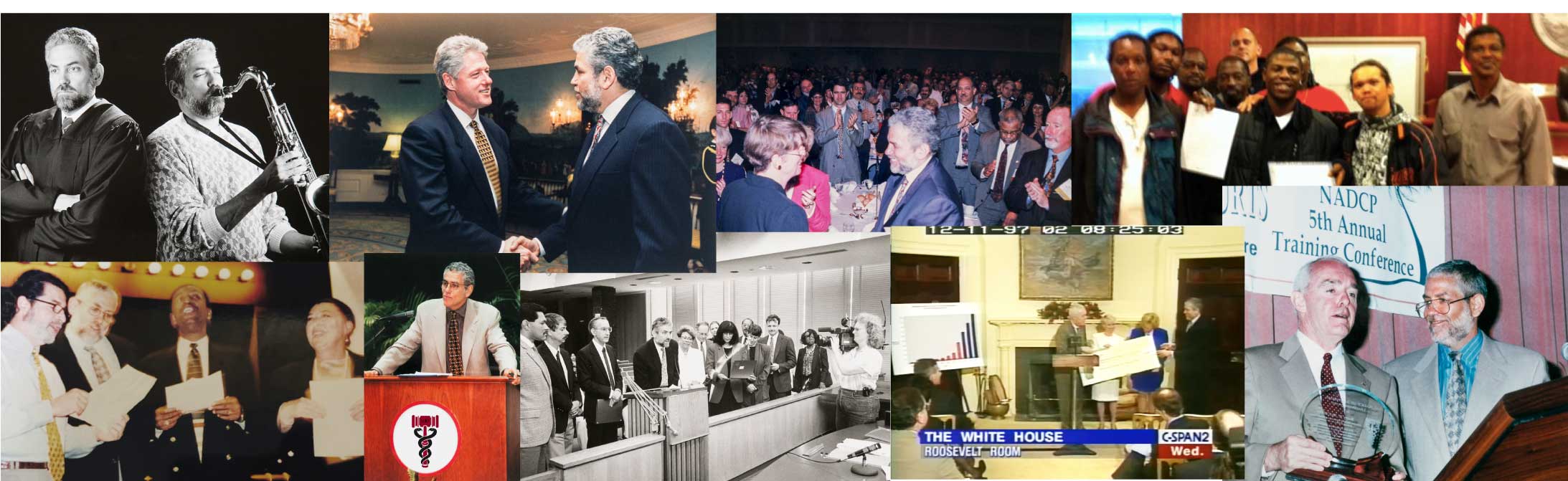
Twenty years ago, along with other drug court pioneers, I helped build a national reform movement that today claims over twenty-five hundred drug and other problem-solving courts. And while I am truely proud  of our successes,  the truth is that the criminal justice system remains overly-cautious, limiting drug courts to the less severe drug abuser and/or the less serious criminal, reaching perhaps only 5% of drug offenders.  This makes little sense as drug court’s scientifically proven effectiveness lies with the high-risk non-violent substance abusers who make up more than 50% of prisoners (Marlowe).

We live in a country plainly addicted to prison; with the highest imprisonment rate in the world, a prison population that has increased 700% since 1970,  over 75% imprisoned for non-violent offenses, and 50% returned to prison within three years of release.  It’s not that prison isn’t  necessary , but that we’ve become habituated to its use, whether appropriate or not . We are just coming out of the addict’s denial phase,  and beginning to accept the fact that our overdependence on prison has catastropic social and financial consequences. But as with all recovering addicts, there is reason to hope for a better future . The reentry court is clearly not the whole answer to our prison addiction (for example, it will also take dedicated partners in a host of rehabilitation services), but as the evolutionary next-generation drug court, there is excellent reason to believe reentry court will be part of the solution. [see  Policy Papers, for a full exposition]

Contact: jtauber@reentrtcourtsolutions

© 2007 -  Reentry Court Solutions. All Rights Reserved.


Reentry Court Solutions Powered by Communications Team