A Federal Drug Court Funding Restriction

May 6, 2013

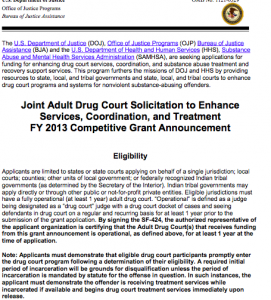
Screen Shot 2013-05-06 at 9.52.21 AMA distinctive article, written by Harold Pollack, Eric Sevigny and Peter Reuter, and published in the Huffington Post was reviewed on this website last week (The Trouble with Reentry Courts…). It described how drug courts, while reaching half of U.S. counties, don’t work enough with the  population in greatest need, the high risk drug offender or serious offender with a dependence on drugs and/or alcohol. A recent proposal from the Bureau of Justice Programs (BJA)  and the Substance Abuse and Mental Health Services Administration (SAMHSA) may unintentionally institutionalize that unfortunate circumstance.

The most striking  feature of that proposal is  a restriction that has only been part of the Drug Court Funding Program since 2012: “Note: Applicants must demonstrate that eligible drug court participants promptly enter the drug court program following a determination of their eligibility. A required initial period of incarceration will be grounds for disqualification unless the period of incarceration is mandated by statute for the offense in question. In such instances, the applicant must demonstrate the offender is receiving treatment services while incarcerated if available and begins drug court treatment services immediately upon release (click on image on the left for a PDF of the BJA/SAMSA Request for Proposal).

Knowing that drug courts are intensive programs, specially designed to work with high risk offenders, who often have serious and/or violent criminal histories, the restriction noted above appears ill-advised. We know that the Congress restricts federally funded drug court programs to non-violent offenders (42 U.S.C. 3797u-2).Only Congress can change that ill-advised restriction. To add that, those who serve a term in custody are also prohibited from BJA/SAMSA funding appears to  contradict the RFP’s rationale. From the text at page 7; “Grant funds must be used to serve high risk/high need populations diagnosed with substance dependence or addiction to alcohol/other drugs and identified as needing immediate treatment”.

This may be a classic example of unintended consequences. The relatively new provision, admirably encourages jurisdictions to reduce their reliance on incarceration as a response to drug dependence, by prohibiting drug court participants from being sentenced  to custody. Unfortunately, it may have a far greater impact on the demographics of the offender class entering federally funded drug courts.  Many drug dependent, high risk offenders, will have committed serious offenses (but not violent offenses) and have extensive criminal histories. To most judges, their criminal behaviors cry out for a custodial response. To the more enlightened , they also cry out for involvement in an intensive drug court program. What now appears to be the case, is that that an otherwise eligible drug court participant, if sentenced to drug treatment in custody, may not be transitioned into a drug court program on that same case post custody. Of course, savy, experienced drug court judges will find their way around the restriction. But the principle (so bolded) will have its impact upon the elligibility requirements of a great many drug courts.

Once again, these are the serious, high risk, high need drug dependent offenders that the research says need to be in drug court programs. In the real world, a petty thief, or car burglar, with a long history of similar crimes will almost always receive time in jail as a consequence of their current and/or past criminal behaviors. That might be a day, a week, a month , a year in county jail, or a term in state prison. Under the new grant restriction, an otherwise appropriate candidate would be excluded (unless he met the limited, mandated incarceration exception to the prohibition; see bolded text above).

This restriction will close the door to many if not most serious offenders with drug dependencies, who might face a term of custody. It seemingly  precludes a collaborative and hopefully seamless application of proven drug court practices for those individuals while in custody and upon release and transition to a drug court program through probation or parole services.. It is not an effective approach to reducing recidivism or protecting society (these folks will soon be in your community with or without the intensive supervision and treatment provided by a drug court).

An American University Technical Assistance Project Report, “LOOKING AT DRUG COURTS AFTER TWO DECADES”,  published in July of 2012, provides an important historical context. Drug Courts need to  “continually move to the more difficult populations – defendants whose drug use is fueling criminal behavior and who may have criminal histories that might have barred them from the program in the past.”

[This article is an independent analysis of 2013 BJA/SAMSA grant funding for Drug Courts; it was not written with the knowledge, consultation, or approval of any other persons or organizations]


“Second Chance Act” Celebrates 5th Anniversary

April 29,2013

Screen Shot 2013-04-29 at 9.01.54 AM[The Second Chance Act, administered by the Bureau of Justice Assistance (BJA), within the Department of Justice (DOJ), has provided hundreds of millions of dollars for reentry projects in every state of the union. Below, the National Reentry Resource Center, provides highlights of BJA's administration of the "Act" (click on image on left for PDF of National Reentry Resource Center Document)]

The Second Chance Act: The First Five Years

This month marks the five-year anniversary of the Second Chance Act, the landmark legislation authorizing federal grants to support programs aimed at improving outcomes for people leaving prisons, jails, and juvenile facilities and reducing recidivism. The bill also funds research and evaluation projects and created the National Reentry Resource Center, a clearinghouse of information relating to prisoner reentry. Through its broad scope and innovative approach, the bill has had a significant impact on all stakeholders: individuals and families in need of services; communities and governments seeking strategies to increase public safety and reduce costs; researchers looking to inform, advance, and disseminate their work; and practitioners interested in enhancing their programs and sharing best practices with others in the field.

The grant program currently funds eight different types of projects: demonstration projects involving the planning and/or implementation of a reentry initiative for adults or juveniles, mentoring services for adults or juveniles, family-based substance abuse treatment for incarcerated parents, reentry courts, programs targeting individuals with co-occurring substance abuse and mental health disorders, funding for state departments of corrections to achieve recidivism reductions through planning and capacity-building, evidence-based strategies in probation supervision, and programs providing training in technology careers. The Office of Juvenile Justice and Delinquency Prevention (OJJDP) manages the juvenile demonstration and juvenile mentoring projects, while the Bureau of Justice Assistance (BJA) of the U.S. Department of Justice manages all the other projects.

To date, BJA and OJJDP have awarded nearly 500 Second Chance Act grants to state, local, and tribal government agencies and nonprofit organizations across 48 states and the District of Columbia, totaling nearly $250 million. Representing a wide range in geography, size, and program design, the grantee programs display the different ways that reentry strategies can be applied in jurisdictions.

Reflecting the importance of reentry as a process that begins during incarceration, grantees must serve individuals both in pre-release and post-release stages. According to BJA’s latest performance reports on its Second Chance Act grantees, the grantees served more than 11,000 participants in pre-release programs and nearly 9,500 participants in post-release programs from July 2011 to June 2012. The vast majority of participants are assessed as medium or high risk, which is in line with research that shows that focusing services and resources on higher-risk individuals has the strongest impact on recidivism.

Some programs have already seen reduced recidivism rates among the people they serve within the first few years of the grant program. For the Harlem Parole Reentry Court in New York, which has received two Second Chance Act grants, preliminary results from an ongoing evaluation showed that the rate of reincarceration at 12 months after release of 14.7 percent for program participants was 24 percent less than a comparison group’s rate of 19.3 percent. The reentry court serves medium- and high-risk adults in Harlemand offers a combination of intensive case management, parole supervision, judicial intervention, clinical services, and other support services. Furthermore, the program employs the evidence-based practice of graduated sanctions and incentives to promote compliance and accountability.

In addition, Second Chance Act grantees have achieved positive outcomes on a number of other measures, including employment, education, family reunification, and pro-social relationships. For instance, the Girl Scouts of Eastern Oklahoma, a 2010 Adult Mentoring grantee, has found that 74 percent of the participants who received employment development services have since obtained employment.

The positive impact of the Second Chance Act can perhaps be best conveyed by the program participants themselves. Since early 2012, the Council of State Governments Justice Center has interviewed program administrators and participants and shared their individual stories in the National Reentry Resource Center (NRRC) website and newsletter. The people featured have included: Wade, a Los Angeles man in his fifties whose participation in the Amity Foundation’s mentoring program helped him overcome his addiction to heroin and become a mentor himself; Frankie, a father in New Mexico who enrolled in PB&J Family Services’ program while in prison and received help finding employment and parenting pre- and post-release; and Janelle, a young woman with co-occurring bipolar and substance abuse disorders who found a job and returned to school after receiving treatment from the Ohio Department of Youth Services’ Second Chance Act-funded program in Franklin County. Each of these stories represents the success and promise of the Second Chance Act and initiatives focusing on prisoner reentry across the country.

Also funded by the Second Chance Act, the NRRC has made great strides in advancing reentry work by promoting and disseminating key information for practitioners, researchers, policymakers, and others in the field. In addition to the website and newsletter, the NRRC offers webinars each month. Recent topics have included work release centers, electronic technology in supervision, and the needs of women in the criminal justice system. The NRRC also produces reports and guides to inform reentry work in practical and constructive ways. Its most recent product is a series of checklists with targeted guidance for state corrections departments and policymakers on building reentry initiatives to reduce recidivism.

The Second Chance Act was signed into law by President George W. Bush on April 9, 2008, after receiving bipartisan support in both chambers of Congress. The bill authorizes up to $165 million per year in grant funds.
 

BJA Second Chance Grant Announced

April 1, 2013

Screen Shot 2013-04-01 at 12.24.03 PMFrom the National Reentry Resource Center:

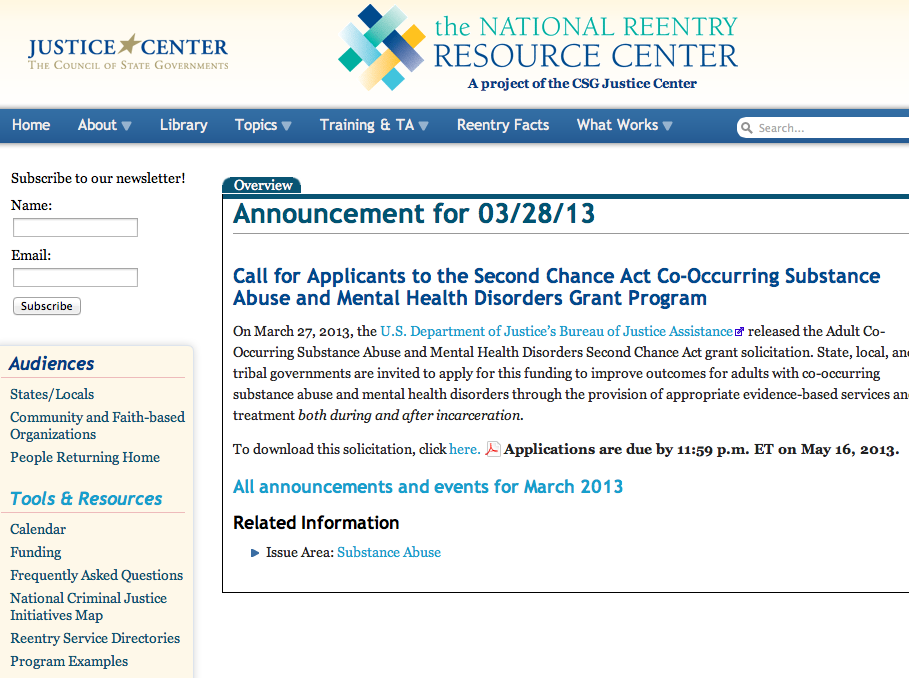
On March 27, 2013, the U.S. Department of Justice’s Bureau of Justice Assistance released the Adult Co-Occurring Substance Abuse and Mental Health Disorders Second Chance Act grant solicitation. State, local, and tribal governments are invited to apply for this funding to improve outcomes for adults with co-occurring substance abuse and mental health disorders through the provision of appropriate evidence-based services and treatment both during and after incarceration.

To download this solicitation, click on the image to the left


2013 BJA Second Chance Act Adult Mentoring Solicitation

Screen Shot 2013-01-27 at 10.56.03 PMJan. 28,2013

As described in the Council of Sate Government’s Press Release ( click on image on the left for PDF of solicitation)

“On January 22, 2013, the U.S. Department of Justice’s Bureau of Justice Assistance released the fiscal year 2013 solicitation for the Second Chance Act Adult Mentoring and Transitional Services for Successful Reentry Program. Nonprofit organizations and federally recognized Indian tribes are invited to apply to receive up to $300,000 over a two-year period to provide mentoring and transitional services to individuals returning from prison or jail. Awards will be made in two categories: mentoring programs for adult offenders generally and mentoring programs that focus on adult offenders who are parents, particularly those who are non-custodial parents. Applicants may apply under Category 1 or Category 2, but not both”

Applications are due by 11:59 p.m. ET on March 21, 2013.


Corporation Makes a Pitch for Guaranteed Prison Occupancy

Nov. 4, 2012

The Corrections Corporation of America (CCA), the nation’s biggest private prison corporation, has ofered to buy prisons in 48 states on condition that the states maintain a 90% occupancy rate for twenty years (described in a comprehensive article by Chris Kirkham in the Huffington Express}


Ohio became the first (and only) state to sell a state-owned penitentiary to a private prison company earlier this year.  The Ohio Department of Rehabilitation and Correction (ODRC), directed by Gary Mohr, has since decided that it would not sell any other penitentiary to a private company. The Ohio Correctional facility, formerly a state prison, bought by the Corrections Corporation of America, (COC) was recently cited for 47 violations. The nature of the violations included quality of food, hygiene and sanitation among many others.

A more central concern is the idea of guaranteeing occupancy in a private prison. It’s hard to imagine local officials, including law enforcement, judges, and other state and county officials pressured into filling  prison beds. Instead of a bounty on imprisonment, we need incentives that do the opposite; reduce the number of prisoners behind bars. No doubt that given discretion, private corporations could reduce the costs of imprisonment, But at what cost. Ohio is in the process of finding that out.

Minimalist Reentry Courts For Recessionary Times

THE BEST OF: The following article, initially updated on March 21, 2009, is the first article I am aware of that described the danger of over-resourcing reentry courts.

MARCH TWENTY-ONE UPDATE:

Over the past four weeks I have interviewed practitioners from four successful reentry courts, and showcased them as model reentry courts on this website: the Harlem Parole Reentry Court(NY), the Boone County Reentry Court(MO), the Richland Reentry Court(OH), and the Fort Wayne Reentry Court(IN).  All displayed what i have described as quasi-minimalist reentry court features (see below), that are non-adversarial and rehabilitation focused, without attorneys on the reentry court team or in reentry court itself; with counsel provided, only when the parole participant has left the reentry court program, and returned to the formal adjudicatory system, whether parole or court based.  From my discussions with reentry court practitioners from across the country, I believe  that the majority of reentry courts can be described similarly.

A number of jurisdictions  that are interested in creating a “parolee reentry court”,  find themselves in a difficult dilemma. Either reject the reentry court concept because of   inadequate funding, or go ahead and build it, but pare back the conventional problem-solving court model to its bare essentials. It’s clear to me that a comprehensive reentry courts, (with full staffing), capable of working with and consolidating an offender’s state and county matters in a single court, is the best possible  solution. But if the necessary funding isn’t avaialble, there is a case to be made for a “minimalist parolee reentry court”, that can reduce court costs, by successfully and lawfully doing  without attorneys, reporters, and clerks. Such a “minimalist reentry court”, may mean substantial savings to the court and community, as well as a smaller, more successful, and sustainable reentry court. [Note: a model "minimalist parolee reentry court" team might include judge, program coordinator, treatment specialist, parole officer, and bailiff]

As a consultant, I’ve sat through many team staffings, and  ”progress hearings” over the years, with more than a dozen team members present.  I often wondered how cost effective or sustainable such  court structures would be in the long run. The answer  has become clear, as hard times  shape  the structures of today’s reentry and other problem-solving courts. Many problem solving courts are closing down, while others severely cut back on participation or services. Interestingly, some of our most successful early drug courts had as few as two team members present at pre-court staffings. The smaller, more intimate courtroom environment, encouraged clear, direct, and personal communication, as well as, increased team involvement and participant engagement; established problem-solving concepts that often lead to better outcomes.

The key hurdle in creating a  hybrid “parole reentry court” with fewer personnel, is the very fact that it’s unconventional. But a Parole Reentry Court, by its very nature is  a minimalist court. Proceedings related to parolees, while evidentiary in nature, are informal, do not involve county jurisdiction (which would require counsel), nor demand the same panoply of procedural and due process rights as a conventional court  (see: Morrisey v. Brewer, 408 U.S. 471 1972, Gagnon v. Scarpelli, 411 U.S. 778 1973). Truth is that there are less than a dozen states that require counsel at “parole revocation hearings”. Clerks and Reporters are not required either, as a written decision setting forth the facts and reasoning upon which it is based, are typically written up by the hearing officer. (Note: the fewer personnel engaged in the legal process, the more resources available for direct services for the returning parolee)

The clear purpose of the minimalist Reentry Court  is to provide an informal and therapeutic enviroment, where the focus is on the rehabilitation and reintegration of the returning parolee in  the community. Some may be uncomfortable with the idea of an informal problem-solving court without counsel present.  But participation in informal courts is typically voluntary, with “parole revocation hearings” passed on to  parole authorities, once the participant has been terminated from the reentry court program.  California has recently  set up  a pilot “Parolee Reentry Courts”  program, where parolees will be referred by parole authorities to the reentry court, admitted only after the parolee voluntarily accepts the program, and the court agrees. The parolee can opt out at any time, (even after a violation), to be returned to the jurisdiction of the parole agency. Ultimately, this model may be an interesting option for those communities with limited funds, a commitment to a reentry court,  but also to “revocation hearings” with counsel present. One of the  most fascinating aspects of the nascent reentry court field, is the many innovative and pragmatic models being developed. The minimalist “Parolee Reentry Court” continues that tradition. [see examples of  quasi-minimalist reentry courts below: Harlem Parole Reentry Court; Ft. Wayne Reentry Court; Richland County Reentry Court; Boone County Reentry Court]

Whether a “minimalist reentry court” is effective, economical or lawful is an open question. If you have a comment, please share it with us.

EXTRA: Importance of Supreme Court Ruling on ACA

Breaking News/July 2, 1012
Former ONDCP Deputy Director Thomas McLellan, describing the impact of the ACA , concludes that the requirement that care services for the full range of substance use disorders be part of the law’s “essential benefit design”, is a  sign of the historic changes to come in our treatment of drug abusers in this country.

Philadelphia; June 29, 2012: A. Thomas McLellan, PhD, CEO of the Treatment Research Institute, and former Deputy Director of the Obama Office of National Drug Control Policy (serving on the Obama Healthcare Reform Task Force), had the following to say about impacts on the substance use/addiction field given the June 28, 2012 decision by the U.S. Supreme Court upholding the Constitutionality of the Patient Protection and Affordable Care Act:

“The decision by the Supreme Court upholding the Constitutionality of the Affordable Care Act (ACA) is an extremely uplifting one for the substance abuse field. The debates and research around the ACA produced two facts that were startling to all involved.

First, unaddressed substance use now costs mainstream healthcare upwards of $100 billion annually, particularly in areas such as ER and trauma care, but also in the treatment of virtually every chronic illness. Because of the severity and complexity of their conditions, the 23 million “addicted” Americans are disproportionately costly – but it is the 40 – 45 million Americans with lower severity but still significant “harmful substance use disorders” who comprise the largest burden of illness and cost to healthcare.

 The second realization produced in the ACA debates is that while there is provision to treat “addiction” in specialty care programs (though clearly more coverage is needed) there had never been healthcare benefits or reimbursement options for those with “harmful substance use.”

 Thus, one of the historic aspects of ACA is the requirement that care services for the full range of substance use disorders be part of the “essential benefit design” in all health plans.

 This is the beginning of a new era in prevention, early intervention and office based care for patients who are not addicted – but whose drinking, smoking, and use of other substances is harming their health and compromising the effectiveness of the care they are receiving for other illnesses and conditions.”

Systemic Approaches to Sentencing: Part 9

May 28, 2012

Evidence-Based Sentencing Systems are Cost-Effective: Part 9

The previous eight articles in this series are testimony to the potential of evidence based sentencing systems. Scientific and technological advances now make these systems cost-effective as well. The most cost intensive aspect of any evidence-based system are the court hearings for felons sentenced to local custody and/or supervision. There is a misconception, that in an evidence-based sentencing system, all felons would be seen in court on a regular basis (as most problem-solving courts tend to do). But science and technology has provided us with strategies and solutions that allow us to substantially reduce the need for additional court sessions and staff (the “Risk Principle”).

Validated risk/needs assessment tools developed over the past ten years allow us to determine a felon’s risk levels and how to best deal with the offender ( see “University of Cincinnatti Study on Risk Principle”) We now know that intensive supervision for low to medium risk offender (involving multiple appearances before the court) actually increases their levels of recidivism. In some jurisdictions, that understanding may actually reduce the total number of court appearances, as only those who have been determined to need intensive supervision and court monitoring would receive it. Felons who are traditionally “banked” as low-risk probationers would almost certainly be excluded. Those offenders who are considered medium risk offenders might be seen by the court on a very limited basis (perhaps one court appearance after beginning their jail sentence, with a second at the start of active probation supervision and a third at the completion of successful probation supervision). Depending on criminal background, history of violence, extent of imprisonment and other relevant factors, high-risk felons would be placed in an appropriate supervision and court monitoring track. (see video at bottom of article, for interview with Reentry Court judge Jeff Tauber, on the intensity of supervision and rehabilitative track required by serious and/or violent high risk parole violators)

A more universal fiscal concern relates to the over-staffing of problem-solving courts. The fact that many courts have more than a dozen employees attending staff meetings and court sessions is a major financial obstacle to the expansion of evidence-based sentencing systems (and other problem solving courts as well).  My experience as both a drug court and reentry court judge suggests problem-solving courts are often over-staffed ( see: A Minimalist Reentry Court for Recessionary Times). My Drug Court staffings in 1990 (admittedly a long time ago) had two persons present, the probation officer personally responsible for offenders to be reviewed, and myself. In a more recent experience on the Bench (2010-2011) , the San Francisco Parole Reentry Court operated with a staff of five; judge, program coordinator, case manager, defense attorney, and parole officer. It should be acknowledged that every problem-solving court has its own staffing requirements,  but the tools described above can also help keep court personnel to a minimum. The development of risk/needs assessment tools allows us to better categorize probation/parole offenders, placing them in customized court tracks, limiting the court time of program specialists, to sessions where their skills are truly needed. Similarly, technology allows us to share information and communications between program personnel and staff, limiting  the need for those present in court.

Finally, even problem-solving courts with significant operating cost, have shown themselves to be cost-effective (see California Study), substantially reducing custody and other criminal justice costs, and providing enormous savings to the community as a whole. This will undoubtedly be the case for evidence-based sentencing systems as well.


New Workshop Added: “Systemic Approaches To Sentencing”

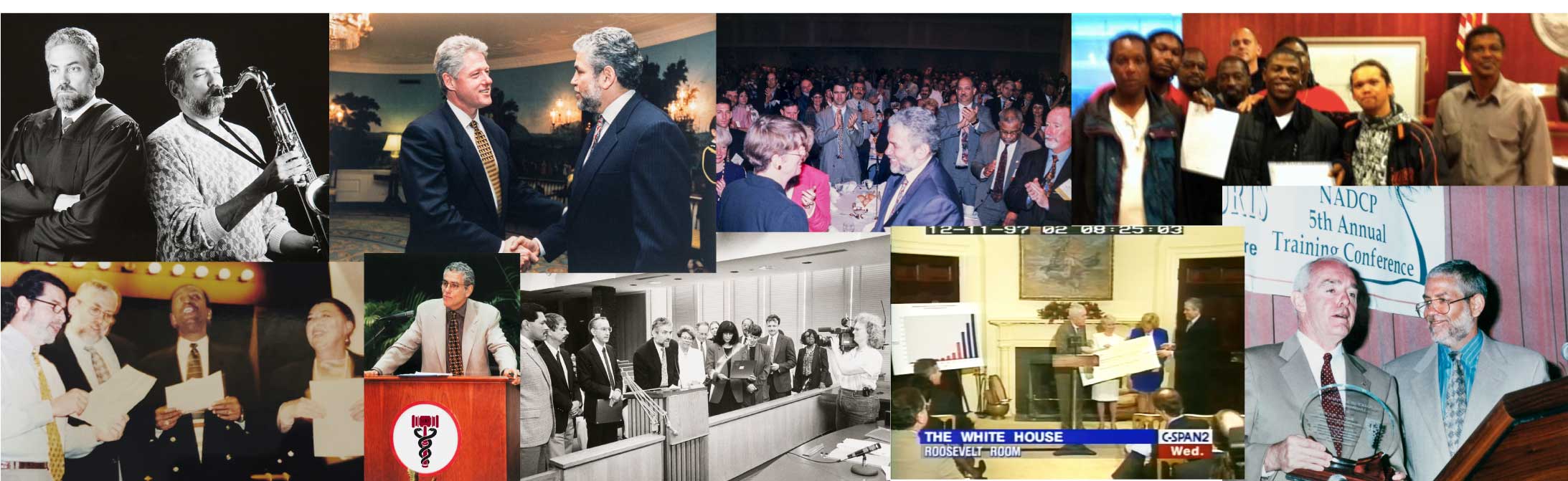
A new Workshop has been added to the Reentry Court Workshop Track, from 4:30 to 5:45 on June 1st at the NADCP Conference in Nashville. The 6th and last workshop session. it will demonstrate how “Systemic Sentencing Approaches” create a seamless process that follows the sentenced offender from sentencing thorugh custody, to community supervision, reducing recidivism and court costs, while improving the court’s capacity to provide effective rehabilliation and monitoring.

The workshop will be presented by Judge Jeff Tauber (ret.), President Emeritus of NADCP. editor of Reentry Court Solutions, and  most recently, the judge in San Francisco’s Parole Reentry Court Demonstration Project.

[Note: the Workshop will be held in Room F13; Governor's Ballroom D. The Workshop is incorrectly entitled,  "Using Court-Based Community to Build Successful Reentry Courts"]


“Second Chance” Solicitation for Statewide Recidivism Reduction

April 16, 2012

The Bureau if Justice Assistance (BJA) has announced a solicitation available to states interested in reducing statewide recidivism. This program will assist states in developing and implementing comprehensive plans to reduce statewide recidivism rates. Applicants must be state departments of corrections to be eligible and the deadline is May 21, 2012.

That is an important, though perhaps obvious point to make. Prison reform may be encouraged and supported by local jurisdictions, but significant changes can only come from the state and thorugh state policy makers. (Council of State Governments’ Reentry Resource Center information on this solicitation can be accessed by clicking on facimile on the left)

Second Chance Act Juvenile Offender Reentry Program Solicitation

April 2, 2012

The Office of Juvenile Justice and Delinquency Prevention,  of the U.S. Department of Justice, is offering a solicitation  for Second Chance Act grant applications to state and local governments and federally recognized Indian tribes for juvenile reentry demonstration projects. This funding is available to help jurisdictions plan and implement programs and strategies to reduce recidivism and ensure safe and successful reentry of juveniles released from prisons, jails, and juvenile detention facilities back to the community. The deadline for applications is May 14, 2012. (You can find out more by clicking on the “National Reentry Resource Center” webpage facimile on the left)

“Second Chance Act” Probation Solicitation Announced

Mar. 5, 2012

“The Second Chance Act” Solicitaition, entitled, “Smart Probation: Reducing Prison Populations, Saving Money, and Creating Safer Communities.” has been announced by the Bureau of Justice Programs (BJA), with a deadline for Applications of May, 21, 2012.

The solicitation itself is aimed at probation agencies and therefore are directly related to (and in many cases subordinate to) the courts. This is a solicitation that the courts ought to be involved in as partners with probation agencies. Note a separate “Second Chance Act” Solicitation, entitiled “Adult Offender Comprehensive Statewide Recidivism Reduction Demonstration Program” is aimed specifically at State Departments of Corrections, and less likely to invove the courts.

[To access the "Probation Solicitation" and learn more about its details; click on the National Reentry Resource Center (NRRC) facimile on left]


Yes; “Second Chance” Grants Are Available to Reentry Courts

Mar. 19, 2012

Three BJA “Second Chance Act” Demonstration Solicitations

If you’ve read the three “demonstration Grant” Solicitations under the “Second Chance Act, you’ll find little mention of the courts.  The funds referenced in last weeks article (“Three Second Chance Solicitations”), appear to primarily target state or local government agencies. That would appear to eliminate involvement of individual courts themselves (at least as to the “Planning and Demonstration Solicitation” where there is no reference to courts at all). But there’s no reason that an individual court  should not be a beneficiary, along with the rest of the community, from resources made available through the “Second Chance Act”.

Note the language in the Solicitation (Second Chance Act Adult Offender Reentry Program for Planning and Demonstration,  Projects; p.4)

“Within the context of this initiative, “reentry” is not envisioned to be a specific program, but rather a process that begins when the offender is first incarcerated (pre-release) and ends with the offender’s successful community reintegration (post-release), evidenced by lack of recidivism”.

There is little reason to believe that that language can be satisfactorily applied without the participation of the courts. The court sentences the offender to custody and has supervisory responsibilities for the returning offender in many cases (from jail and/or prison). So if you have a reentry court, or wish to involve your court in a community based reentry system in your locality, you have the right and even the obligation to do so.

Each Solicitation requires that the community develop a “Reentry Task Force comprised of relevant state, tribal, territorial, or local leaders and representatives of relevant agencies, service providers, nonprofit organizations, and other key stakeholders” (see Solicitation, p.5). With the understanding that the courts will not likely be the applicant nor the direct receiver of funds (at least as to “Planning and Demonstration Projects”), courts need to be “key stakeholders”, who benefit, along with the community, when resources are made available to felons under the court’s supervisory authority.


A County Jail Based Reentry Court Grant Application

June 9th

This is one of many articles  I’ve written on the 2011 “Second Chance Act” Reentry Court RFP, in an attempt to stir interest in a major funding opportunity involving community alternatives to prison. In this analysis,  I will review the Reentry Court RFP from the perspective of a  county -jail, probation-based reentry court applicant.

Typically, when one thinks of a reentry process, the focus is on state prisoners reentering society.  While this is clearly a critical issue, the possibility of keeping the offenders in the local community , and using a substantial jail term as a last resort to prison has not always received the focus it deserves. Creating an effective county jail-based reentry court program offers the possibility of reducing the state prison population with its extraordinary costs, keeping offenders local, while increasing public safety within a seamless and comprehensive jail-based reentry court system.

Note: This solicitation is open to offenders returning from jails as well as prisons.

The pressure is on to reduce prison population in states like California. Governor Jerry Brown has committed  his new administration to implementing a major sentencing realignment that will optimally send 30,000 state prisoners back to local communities and county court jurisdiction.  The potential for dealing with offenders at an early stage of the criminal justice process (potentially at Arraignment), allowing for the seamless transitioning from jail to community, providing judicial oversight and incentives, using the same reentry court team throughout, and providing critical rehabilitation services early on, is an important alternative to prison based reentry court (see: County Jail Based Reentry Courts, a Policy Paper). An additional benefit, is that the local jurisdiction can submit an application and proceed with their planned reentry court, even in states that don’t support state prison-based reentry courts.

It’s worth repeating, that an obvious way to deal with exploding prison populations and prisoner reentry failures is to refrain from sentencing non-violent offenders to prison in the first place.

SAMSHSA makes Reentry Court Funding Available

Breaking News: Grant Deadline:June 6th

$4.4 million will be made available under this grant, with up to $400 thousand made available to individual jurisdictions.

This new grant program combines the Substance Abuse and Mental Health Services Administration’s (SAMHSA’s) drug court and offender reentry treatment services programming and funding with its mental health diversion and systems transformation programming and funding.  The grant program is open to all criminal justice and family/child dependency courts, as well as reentry courts.

[It should be noted that there are elligibility requirements that limit the use of these funds to court programs that have been in existence at least one full year]

To learn more about this opportunity, you are encouraged to participate in the free webinar hosted by SAMHSA on Tuesday, April 26, from 3 to 5 p.m. EDT. CALL: 1-888-453-4221 (Access code 676520 and then press #) LOG INTO: htttps://jbsinternational.webex.com (Meeting number: 572 187 472 / password: samhsa)