
A Federal Drug Court Funding Restriction

May 6, 2013

Screen Shot 2013-05-06 at 9.52.21 AMA distinctive article, written by Harold Pollack, Eric Sevigny and Peter Reuter, and published in the Huffington Post was reviewed on this website last week (The Trouble with Reentry Courts…). It described how drug courts, while reaching half of U.S. counties, don’t work enough with the  population in greatest need, the high risk drug offender or serious offender with a dependence on drugs and/or alcohol. A recent proposal from the Bureau of Justice Programs (BJA)  and the Substance Abuse and Mental Health Services Administration (SAMHSA) may unintentionally institutionalize that unfortunate circumstance.

The most striking  feature of that proposal is  a restriction that has only been part of the Drug Court Funding Program since 2012: “Note: Applicants must demonstrate that eligible drug court participants promptly enter the drug court program following a determination of their eligibility. A required initial period of incarceration will be grounds for disqualification unless the period of incarceration is mandated by statute for the offense in question. In such instances, the applicant must demonstrate the offender is receiving treatment services while incarcerated if available and begins drug court treatment services immediately upon release (click on image on the left for a PDF of the BJA/SAMSA Request for Proposal).

Knowing that drug courts are intensive programs, specially designed to work with high risk offenders, who often have serious and/or violent criminal histories, the restriction noted above appears ill-advised. We know that the Congress restricts federally funded drug court programs to non-violent offenders (42 U.S.C. 3797u-2).Only Congress can change that ill-advised restriction. To add that, those who serve a term in custody are also prohibited from BJA/SAMSA funding appears to  contradict the RFP’s rationale. From the text at page 7; “Grant funds must be used to serve high risk/high need populations diagnosed with substance dependence or addiction to alcohol/other drugs and identified as needing immediate treatment”.

This may be a classic example of unintended consequences. The relatively new provision, admirably encourages jurisdictions to reduce their reliance on incarceration as a response to drug dependence, by prohibiting drug court participants from being sentenced  to custody. Unfortunately, it may have a far greater impact on the demographics of the offender class entering federally funded drug courts.  Many drug dependent, high risk offenders, will have committed serious offenses (but not violent offenses) and have extensive criminal histories. To most judges, their criminal behaviors cry out for a custodial response. To the more enlightened , they also cry out for involvement in an intensive drug court program. What now appears to be the case, is that that an otherwise eligible drug court participant, if sentenced to drug treatment in custody, may not be transitioned into a drug court program on that same case post custody. Of course, savy, experienced drug court judges will find their way around the restriction. But the principle (so bolded) will have its impact upon the elligibility requirements of a great many drug courts.

Once again, these are the serious, high risk, high need drug dependent offenders that the research says need to be in drug court programs. In the real world, a petty thief, or car burglar, with a long history of similar crimes will almost always receive time in jail as a consequence of their current and/or past criminal behaviors. That might be a day, a week, a month , a year in county jail, or a term in state prison. Under the new grant restriction, an otherwise appropriate candidate would be excluded (unless he met the limited, mandated incarceration exception to the prohibition; see bolded text above).

This restriction will close the door to many if not most serious offenders with drug dependencies, who might face a term of custody. It seemingly  precludes a collaborative and hopefully seamless application of proven drug court practices for those individuals while in custody and upon release and transition to a drug court program through probation or parole services.. It is not an effective approach to reducing recidivism or protecting society (these folks will soon be in your community with or without the intensive supervision and treatment provided by a drug court).

An American University Technical Assistance Project Report, “LOOKING AT DRUG COURTS AFTER TWO DECADES”,  published in July of 2012, provides an important historical context. Drug Courts need to  “continually move to the more difficult populations – defendants whose drug use is fueling criminal behavior and who may have criminal histories that might have barred them from the program in the past.”

[This article is an independent analysis of 2013 BJA/SAMSA grant funding for Drug Courts; it was not written with the knowledge, consultation, or approval of any other persons or organizations]




The Trouble with Reentry Courts……

April 29, 2013

In the title of this blog and its substance, I am extrapolating on issues presented in an excellent article, “How to Make Drug Courts Work”,  authored by Harold Pollack, Eric Sevigny and Peter Reuter, published in the Washington Post  (April 26,2013). The issues explored relating to drug courts are almost identical to those facing other problem-solving courts or specialty courts, including reentry courts.

In the Post article, its authors lament that drug courts and other specialty courts are slated to receive $80 million with possibly little to show for it. They point out that although numerous (half of all counties claim to have a drug court), they average only 50 participants. More significantly, too many courts stick to a limited, and political cautious approach to their specialty courts. By that i mean they screen out the serious or violent offender, and work with those who need the intensive specialty court services the least. As Professor Ed Latessa has highlighted in his research at the University of Cincinati; spending money, resources and energy on low to medium risk offenders, whose offenses are non-serious and non-violent is a poor use of limited resources (see in this website: “High Risk Offenders do Better in Half-Way Houses”). As the article’s authors succinctly put it,”Drug courts could be more helpful in reducing crime and incarceration, but only if they become more ambitious and less risk-averse by taking in populations likely to serve real time”.

And here is where Reentry Courts come in. Reentry Courts don’t focus on drug abusers unless they have a serious drug dependency. They do focus on offenders coming out of custody who have served “real time” for serious and/or violent offenses. That is their purpose, whether there is a drug dependency or not. Keep in mind that these offenders will overwhelmingly be released with or without the serious supervision and rehabilitation services of a Reentry Court. What possible sense does it make, to work with those who pose the least risk to society and benefit the least from an intensive intervention like Drug or Reentry Court.

The authors argue that drug courts [and reentry courts by extension] widen the net of formal social control. That “Even if these drug court participants had been incarcerated, many would likely have received short terms, often in county jails, for less than a year”. It is as if fishermen were to pull in their nets and throw the big fish back and harvest the small fish. It is not logical, does not make our communities safer or serve them well. But we  continue to keep the small fry, and let the big fish return to the wild.

“Second Chance Act” Celebrates 5th Anniversary

April 29,2013

Screen Shot 2013-04-29 at 9.01.54 AM[The Second Chance Act, administered by the Bureau of Justice Assistance (BJA), within the Department of Justice (DOJ), has provided hundreds of millions of dollars for reentry projects in every state of the union. Below, the National Reentry Resource Center, provides highlights of BJA’s administration of the “Act” (click on image on left for PDF of National Reentry Resource Center Document)]

The Second Chance Act: The First Five Years

This month marks the five-year anniversary of the Second Chance Act, the landmark legislation authorizing federal grants to support programs aimed at improving outcomes for people leaving prisons, jails, and juvenile facilities and reducing recidivism. The bill also funds research and evaluation projects and created the National Reentry Resource Center, a clearinghouse of information relating to prisoner reentry. Through its broad scope and innovative approach, the bill has had a significant impact on all stakeholders: individuals and families in need of services; communities and governments seeking strategies to increase public safety and reduce costs; researchers looking to inform, advance, and disseminate their work; and practitioners interested in enhancing their programs and sharing best practices with others in the field.

The grant program currently funds eight different types of projects: demonstration projects involving the planning and/or implementation of a reentry initiative for adults or juveniles, mentoring services for adults or juveniles, family-based substance abuse treatment for incarcerated parents, reentry courts, programs targeting individuals with co-occurring substance abuse and mental health disorders, funding for state departments of corrections to achieve recidivism reductions through planning and capacity-building, evidence-based strategies in probation supervision, and programs providing training in technology careers. The Office of Juvenile Justice and Delinquency Prevention (OJJDP) manages the juvenile demonstration and juvenile mentoring projects, while the Bureau of Justice Assistance (BJA) of the U.S. Department of Justice manages all the other projects.

To date, BJA and OJJDP have awarded nearly 500 Second Chance Act grants to state, local, and tribal government agencies and nonprofit organizations across 48 states and the District of Columbia, totaling nearly $250 million. Representing a wide range in geography, size, and program design, the grantee programs display the different ways that reentry strategies can be applied in jurisdictions.

Reflecting the importance of reentry as a process that begins during incarceration, grantees must serve individuals both in pre-release and post-release stages. According to BJA’s latest performance reports on its Second Chance Act grantees, the grantees served more than 11,000 participants in pre-release programs and nearly 9,500 participants in post-release programs from July 2011 to June 2012. The vast majority of participants are assessed as medium or high risk, which is in line with research that shows that focusing services and resources on higher-risk individuals has the strongest impact on recidivism.

Some programs have already seen reduced recidivism rates among the people they serve within the first few years of the grant program. For the Harlem Parole Reentry Court in New York, which has received two Second Chance Act grants, preliminary results from an ongoing evaluation showed that the rate of reincarceration at 12 months after release of 14.7 percent for program participants was 24 percent less than a comparison group’s rate of 19.3 percent. The reentry court serves medium- and high-risk adults in Harlemand offers a combination of intensive case management, parole supervision, judicial intervention, clinical services, and other support services. Furthermore, the program employs the evidence-based practice of graduated sanctions and incentives to promote compliance and accountability.

In addition, Second Chance Act grantees have achieved positive outcomes on a number of other measures, including employment, education, family reunification, and pro-social relationships. For instance, the Girl Scouts of Eastern Oklahoma, a 2010 Adult Mentoring grantee, has found that 74 percent of the participants who received employment development services have since obtained employment.

The positive impact of the Second Chance Act can perhaps be best conveyed by the program participants themselves. Since early 2012, the Council of State Governments Justice Center has interviewed program administrators and participants and shared their individual stories in the National Reentry Resource Center (NRRC) website and newsletter. The people featured have included: Wade, a Los Angeles man in his fifties whose participation in the Amity Foundation’s mentoring program helped him overcome his addiction to heroin and become a mentor himself; Frankie, a father in New Mexico who enrolled in PB&J Family Services’ program while in prison and received help finding employment and parenting pre- and post-release; and Janelle, a young woman with co-occurring bipolar and substance abuse disorders who found a job and returned to school after receiving treatment from the Ohio Department of Youth Services’ Second Chance Act-funded program in Franklin County. Each of these stories represents the success and promise of the Second Chance Act and initiatives focusing on prisoner reentry across the country.

Also funded by the Second Chance Act, the NRRC has made great strides in advancing reentry work by promoting and disseminating key information for practitioners, researchers, policymakers, and others in the field. In addition to the website and newsletter, the NRRC offers webinars each month. Recent topics have included work release centers, electronic technology in supervision, and the needs of women in the criminal justice system. The NRRC also produces reports and guides to inform reentry work in practical and constructive ways. Its most recent product is a series of checklists with targeted guidance for state corrections departments and policymakers on building reentry initiatives to reduce recidivism.

The Second Chance Act was signed into law by President George W. Bush on April 9, 2008, after receiving bipartisan support in both chambers of Congress. The bill authorizes up to $165 million per year in grant funds.


California Struggles to Continue Prison Reform

April 22,2013

Screen Shot 2013-04-22 at 10.29.20 AMCalifornia is being pushed toward furthering prison reform goals by a three judge panel that has just reaffirmed its 2009 order to reduce the prison population to 109,000 o 137.5% of prison capacity. As the result of a far reaching prison reform statute (AB109, passed in 2011), the prison population has been reduced by 23,000 inmates since October 2011. to 119,542 or 149.5% of capacity..

California Governor Jerry Brown (image on the left) has argued that California have complied with the court’s order; that California prisons are habitable and its health care system adequate. The court disagreed. On April 12, the three judge panel,U.S. District Judges Lawrence Karlton in Sacramento and Thelton Henderson in San Francisco and Stephen Reinhardt,  of the U.S. 9th Circuit Court of Appeals in Los Angeles —  demand that the state reduce its prison population by another 9,500 inmates as per their previous order.The court threatened Brown and other government officials with contempt of court. The Court extended the original deadline for the reduction from June,  to December. Governor Brown promised to appeal the courts decision tot the U.S. Supreme Court.

California has been able to reduce its inmate population substantially by keeping low-level offenders in local jails instead of sending them to state prisons (and restricting the ability of parole or the courts to return them to prison). Progress toward meeting the cap has slowed, however, and officials have been reluctant to consider other ways to ease crowding. on the ground that further steps to free up space in prisons would “unnecessarily jeopardize public safety”( Los Angeles Times)..

The judges disagreed. “Releasing comparatively low-risk inmates somewhat earlier than they would otherwise have been released has no adverse effects on public safety. The state could meet the year-end deadline by transferring elderly and ill prisoners to community-based facilities, paroling some aging inmates who are serving terms of up to life in prison but pose little risk, and increasing sentence reductions for good behavior” (San Francisco Chronicle)

I believe that the court is correct. The  reduction in prison population by 9500 prisoners can be reached by releasing those who are infirm, aged, or deemed little risk to public safety. But that is just the beginning of our task. If Brown reduces California’s prison population to 109,000, the states’s prisons will still be 137.5% over capacity. California prisons need to reduce their populations below capacity. That will be a good start toward real prison reform in California, where only the serious and dangerous offender is sent to state prison (for a brief analysis as to how this might be accomplished , see on this website: Longer is not necessarily Better)

Tragic Murder of Colorado Corrections Chief

April 8, 2013

Screen Shot 2013-04-07 at 8.24.03 PMIt’s been hard to follow the horrific story coming out of Colorado over the past weeks. The Colorado Corrections Chief Tom Clements was murdered outside of his home, by Evan Ebel, a recently released state prison parolee ( see Denver Post article, March 31, 2013)

The story is complicated and continues to evolve, with the arrest of a white supremacist prison ringleader for questioning. But rather than review the evidence relating to the homicide, this might be a good time to look at the possible causes, problems and consequences of the murder of Tom Clements (image at left; Lisa Clements, the widow of Tom Clements, speaks at his public memorial at New Life Church in Colorado Springs, on March 25)

This story id not going away, Governor Hickenlooper has just announced a sweeping review of the state’s prison and parole operations, along with a request of the National Institute of Justice (NIJ) to investigate parole procedures in Colorado. These are, in fact, appropriate steps to be taken after the shocking murder of the Corrections Chief. But even in this incredibly horrific example of parole gone wrong, there are important lessons to be learned. and they go beyond some of the claims that parolee Ebel was erroneously released four years early on a twelve year term.

I’m not convinced that there was an actual clerical error involved in this case. Apparently the judge did not state that the sentences should run consecutive, so the clerk indicated they would run concurrent (the same time credited for two different sentences). Many states consider that kind of judicial mistake (after all it was the judge who failed to state the offenses were to run consecutive), to be an act of clemency and run the sentences concurrent as a matter of law. But really this is just one of a number of red herrings in this case.

Evan Ebel was seriously mentally ill. He had spent his last two years in prison in administrative segregation (read solitary). He was released directly from solitary onto the streets of Denver with no special preparation, or even half-way house residency. He was a time bomb ready to explode. It most likely would have happened, but with another victim under other circumstances.

Remember few prisoners spend their lives in prison. In Ebel’s case, he was sentenced to an eight year prison term and had four years tacked on for assaulting a prison officer. Prison officials had plenty of notice that Ebel would be reentering society. Everyone in contact with him must have known it was not going to be easily accomplished. But there was an opportunity to prepare for it.

It may be that Evan Ebel was one of those persons who will be horribly violent no matter what is done to prevent it. But there is no information that he received any special prison supervision (except for 2 years of Solitary) as he approached release or when he was released into the community under the supervision of parole officials (though there were apparently therapeutic conditions for parole).

This is one of those occasions when one particularly horrible crime can destroy the momentum toward prison and parole reform. Stop all reform because there has been a horrible crime. To few consider that there are horrible crimes committed whether we release some offenders early and/or apply alternatives to prison to others. In Colorado, the statistics suggest that prison reform was working. Crime has plunged by 30% over the past four years, but that fact is likely to be buried in the lamentations over this terrible crime. The irony of the matter is that Tom Clements was the leader in efforts to reform the corrections system and reduce the number of prisoners in Colorado prisons.

There will likely be many scape goats in this story before it goes away; from prison officials to  mental health counselors , judges, to court clerks,  parole officials to parole officers, and on up to the governor. It may be best to remember that there will be horrible crime that we cannot prevent, and that ultimately it is society’s job to reduce those crimes to an absolute minimum, but we won’t ever be able to stop them all. And that locking people up for longer and longer prison terms, or keeping them in solitary confinement for long periods is a fool’s answer to a very complex problem.


BJA Second Chance Grant Announced

April 1, 2013

Screen Shot 2013-04-01 at 12.24.03 PMFrom the National Reentry Resource Center:

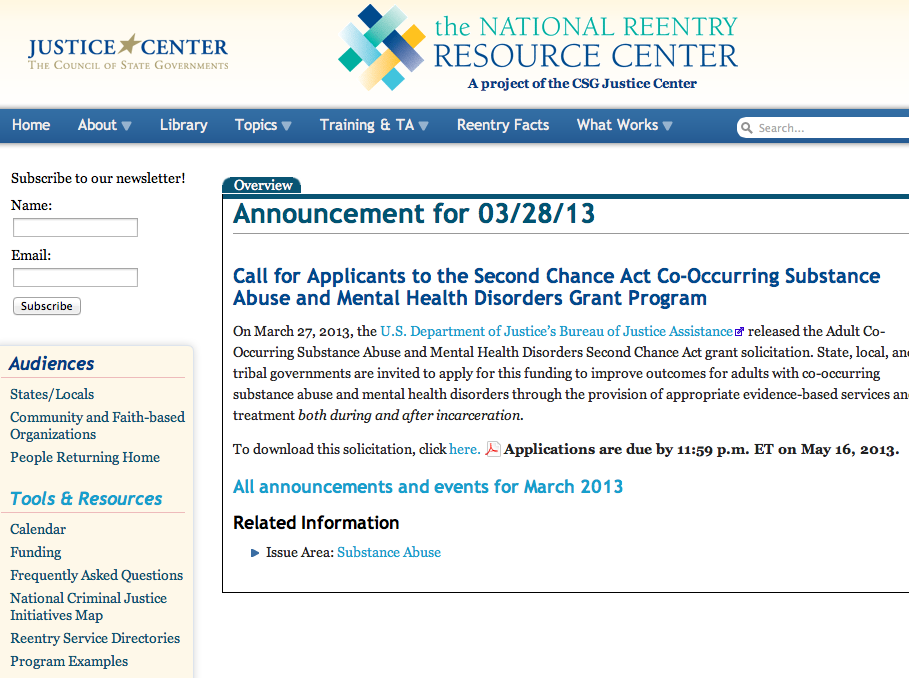
On March 27, 2013, the U.S. Department of Justice’s Bureau of Justice Assistance released the Adult Co-Occurring Substance Abuse and Mental Health Disorders Second Chance Act grant solicitation. State, local, and tribal governments are invited to apply for this funding to improve outcomes for adults with co-occurring substance abuse and mental health disorders through the provision of appropriate evidence-based services and treatment both during and after incarceration.

To download this solicitation, click on the image to the left


Letter of Commendation to Senator Paul

NOTE: Last week, I wrote of Senator Rand Paul’s support for the “The Justice Safety Valve Act of 2013″ and his positions on other criminal justice issues (see article immediately below). Here is the letter i sent to him (as promised), for publication, and your consideration.


April 1, 2013

208 Russell Senate Office Building
Washington DC, 20510

Dear Senator Paul,

I am writing as a retired California Judge, and editor of a small internet site focused on prison reform (“reentrycourtsolutions.com” ).

I wish to commend you for your co-authoring of “The Justice Safety Valve Act of 2013″, a federal prison reform bill, with Senator Patrick Leahy of Vermont.  I was heartened by your position against federal mandatory sentencing in that bill as well as your position that too many offenders are being sent to federal prisons for terms that are out of proportion to the offenses committed.

As someone who favors prison reform, I sincerely hope that you will continue to speak out on criminal justice and prison reform issues. I believe that your positions on these and other criminal justice issues are placing you at the forefront of those concerned about the ascendance of oppressive practices that threaten out constitutional rights and threaten our personal liberties.

Judge Jeffrey Tauber (ret.)

Editor, Reentry Court Solutions

Senate Bill to modfiy Mandatory Minimums

Sen. Rand Paul photo rand-paul.jpgTwo sentators, Leahy of Vermont, and Rand of Kentucky, have introduced far-reaching legislation, “The Justice Safety Valve Act of 2013”. The bill, if passed, gives federal judges greater latitude in making sentencing decisions.  Ultimately, this could be the beginning of the end of “Federal Mandatory Minimums”.

What is so extraordinary about this effort is not that Democratic Senator Leahy has introduced the bill, or that it is bipartisan effort, but who the republican co-sponsor of the bill is. Rand Paul has been making a name for himself, taking libertarian stands on everything from filibustering  the use of drones within the U.S., to adocating for non-custodial sentences for marijuana users . His championing of flexibility for federal judges’ sentencing, should be a clear sign to the right that this is a safe position to take in the battle over prison reform.

Paul is quoted as saying “Our country’s mandatory minimum laws reflect a Washington-knows-best, one-size-fits-all approach, which undermines the Constitutional Separation of Powers, violates the our bedrock principle that people should be treated as individuals, and costs the taxpayers money without making them any safer. This bill is necessary to combat the explosion of new federal criminal laws, many of which carry new mandatory minimum penalties.”

 I could not have said it any better. Alllies sometimes come from the strangest places. I am going to write him a letter, thanking him for taking his position on federal manatory minimums. This might be a good use of your time as well. I’ll release mine, when the next edition of RCS is published, next Monday,

Cal. Repub introduce bill to roll back Realignment

March 25, 2013

Screen Shot 2013-03-24 at 5.51.53 PMSenaor Morell (R-Rancho Cucamonga), introduced a bill last week that would substantially alter the realignment reform Plan currenty in place in California. Republican leaders in the state Senate and Assembly had included Morrell’s bill as part of a 13-point plan to reform “realignment. The Assembly Public Safety Committee voted Morell’s bill down March 12 on a party-line vote.

Among other substantial modifications, was a change in the law that would allow those with a three year sentence or greater, to be sent to State Prison. It isn’t strain see how that modification would devastate the current realignment’s  intent to keep less serious offenders under county supervision, and financial responsibility with the county. The provision alone is a major reason that state prisons populations have been reduced by over 40,000 prisoners over the past two years.

Virtual Incarceration is Here!

March 19,2013

Screen Shot 2013-03-19 at 10.02.16 AMIt sounds like something out of an “Arnold” movie. We all knew it was coming. GPS, home detention, long range alcohol detection, all were leading us to the next level of alternatives to custody; “Virtual Incarceration”. Personally, it’s taken a while before I could climb aboard the band wagon, but here I am. There are people that need to be in prison because they are a danger to society and there are those, at the other end of the spectrum of supervision, that can be supervised, monitored , and even treated through digital technology.

Public Radio international, reports that, “A group of panelists at this year’s South by Southwest interactive media conference in Austin, Texas, presented an idea to improve the U.S. prison system with smart phone technology.The consulting firm, Deloitte, and its think-tank, GovLab, led a discussion on alternatives to the brick-and-mortar prisons low-level criminals are sent to. suggested the U.S. keep low-level criminals out of prison, using smart phone technology”. (click on the image on the left for the article and audio of the panel discussion)

One senior consultant for Deloitte, suggested “virtual incarcerations,” where nonviolent, low-level offenders are taken out of prison cells with support and monitoring that keeps both the community and the offender safe.

“When a court determines a low-level criminal is a good candidate for the smart phone program, they would be equipped with an ankle-monitoring device to track them with GPS, and given a locked smartphone with specific apps related to their needs.” For example,  A DUI offender might require Breathalyze, an app that detects eye movements in the camera on your phone”. The app would also allow the offender to meet with his parole officer via FaceTime on his phone.

These are good ideas, many of which are already being used in some jurisdictions. But it would be interesting to see a pilot project that put together all aspects of high tech supervision into what is now called “Virtual Imprisonment”.

Oklahoma turns back on Prison Reform

March 18,2013

Screen Shot 2013-03-19 at 11.57.54 AMOaklahoma consistently is among the top five states in the use of incarceration (number one for women). Under these circumstances one might expect it to follow in the steps of its conservative neighbors, especilly Texas, who have led in the extraordinary reduction in imprisonment and adoption of alternative to prison policies.

That was the case until recently, when according to the City Centinel, Governor Mary Fallin’s administration did an about face in its commitment to prison reform. The “justice reinvestment” initiative” (JRI), has in recent weeks seen a substantial weakening of prison reform plans, culminating in the resignation of JRI author Kris Steele, former speaker of the state House, from the inter-agency and private sector working group that was overseeing implementation”….Once again according to the Sentinel,”Gov. Mary Fallin’s legal counsel, Steve Mullins, has guided major shifts in administration and oversight in recent weeks, effectively gutting the infrastructure that led implementation until mid-February.”

The easiest way to follow the conflict and its various parambuations is to look at the individuals these changes are likely to affect.

According to Corrections Officials,” only a handful of parole violators were in the agency’s pipeline for intermediate sanctions (short of a return to full-fledged imprisonment) for what were described as technical rather than substantive or deliberate parole violations. While” Mental Health Department officials, in contrast, described early implementation touching more than 120 individuals…”

The “Tulsa World” describes this latest failure of will, as just one of a long history of planned prison reform failures in Oklahoma. This, of course, is just another example of the backsliding we are observing, as conservative states and jurisdictions actually come up against real reform and its consequences. More than a few step back from the brink, a phenomenum that is important to note and report as happens.

As I’ve descried in the past, the failure of states to embrace reform is important to note, but failures to implement or provide the  structure, resource or institutional support that can make prison reform and reductions in recidivism real, are a more insidious form of failure, that we need to be ever vigilant about.

Federal Reentry Courts and Other New Models of Supervision

March 11, 2013

Screen Shot 2013-03-11 at 2.09.10 PM


A new article on Federal Reentry Courts, by the Honorable Laurel Beeler, has been published in the March edition of the Federal Lawyer. It deals with the different models of Reentry Court as well as other problem-solving courts available at the federal court level (click on image on the left for full PDF of article).

The article  provides general information and an excellent introduction for those with an interest but little background in Federal Reentry Courts.


1 Year Process Evaluation of 8 Reentry Courts

March 11, 2013

Picture 3The DOj is putting money and effort into a project that  focuses on the  development of court based reentry efforts. One can sometimes get the impression that the courts are not a significant focus in the  federal government’s approach to state prison reentry issues. This project shows the opposite to be true.

The National institutue of Justice has released a one year process evaluation of eight Adult Reentry Courts that are sponsored under the BJA Second Chance Act. The National Institute of Justice’s “Evaluation of Second Chance Act Adult Reentry Courts: Program Characteristics and Preliminary Themes from Year 1”, was authored by Christine Lindquist, Jennifer Hardison Walters, Michael Rempel, and Shannon M. Carey. The document is the product of RTI International, The Center for Court innovation and NPC Research.  (click on image on the left for PDF of evaluation)

The eight reentry court jurisdictions being funded and evaluated are Union County, Arkansas, New Castle County, Delaware, Pinellas County, Florida, Boone County, Missouri, Strafford County, New Hampshire, Stark County, Ohio, Bexar County, Texas, and Norfolk County, Virginia.

The process evaluation will document the implementation of the evolving programs through three rounds of site visits, and be followed by an impact evaluation and a cost –benefit evaluation.

 From the I year site visit and process evaluation,

“Several programmatic characteristics were common across most sites, including the emphasis on post-release service delivery, the provision of a breadth of services relevant to the target population (with all sites offering substance abuse treatment and employment services), the use of a case management approach to coordinate and monitor services, the use of court hearings for the purpose of monitoring participants’ progress in the program, the use of drug testing, and a team approach to decision-making regarding sanctions and rewards. In all sites, reentry court participation is used as a condition of supervision, with the sentencing judge retaining jurisdiction over the participant in most sites. Therefore, almost all participants are under community supervision by a parole or probation officer for the entire duration of reentry court participation.”

Penn. to Scrap Current Half-Way House Contracts

March 4,2013

Screen Shot 2013-03-04 at 11.47.48 AMAn article in the Patriot Post, reports that “the state [Pennsylvania] is scrapping all contracts with the private companies that run 38 community corrections centers – better known as half-way houses – requiring them to rebid and making the new contracts performance-based. Pennsylvania is reacting to statistics showing that people who go through half-way houses are actually more likely to return to prison than people paroled directly to the street.

At first, it appears a reasonable plan, but there are concerns that need to be addressed. One issue  relates to the  nature of  different prolee populations in half-way houses.  Those with a high risk assessment may do poorly, as will drug addicts vs. those who are only drug abusers. Furthermore, it makes sense that those who are under greater observation in a half-way house will be found  in violation of their parole at a greater rate than those who are under minimal supervision. These are realities that one would expect the governor’s office to understand.

And then there are the intangibles.. The proposed program intends to include the number of arrests during and after half-way house residence, rather than relying heavily upon returns to prison. In some communities, this plan would give the police license to close down half way houses at will (and possibly return parolees to prison).  In my experience as a Reentry Court Judge in San Francisco, I fould that parolees were arrested more frequently than parolees in any other California county. Upon looking into the matter further, it was obvious that San Francisco parolees were an easy arrest target for police (a parolee with a search clause). Living in a twenty block area known as the Tenderloin, all parolees lived in a ghetto of drug addicts, the mentally ill, those on probation or their Own Recognizance, the old and infirm, and their predators. In a high income city’s ghetto, with little opportunity to live elsewhere, it was nearly impossible for parolees to live  a healthy,drug and crime free life.  In 2010, the return to prison rate for non-reentry court parolees was approximately 78%. Making arrests of parolees in the Tenderloin was like shooting fish in a barrel.

Before instituting an incentive based half-wayhouse program, Pennsyvania may want to review the scientific literature on half-way houses. Those that are most successful have prepared the parolee for the transition to the community while still in prison, providing counseling, education, and job training, and importantly “cognitive behavioral therapies” (the only program dealing with criminogenic risk showing significant success).

People ultimately make a program successful or not. Half way houses often are poorly resourced, with staff who have little expertise or training for their positions. Additionally many states stuff hundreds of transitioning parolees into half-way houses with deplorable but expected results. New Jersey was rocked this past July by revelations in a Series in The New York Times, describing “escapes, drug use, lax security and violence — including sexual assaults — at facilities intended to transition individuals back into the community, often after serving jail time. The report said since 2005, there have been about 5,100 escapes from the state’s halfway houses, many run by Community Education Center”.( a predictable outcome where hundreds of offenders were in individual half-way houses, when what is needed is individual programs made up of a few dozen particpants at best, with a high ratio of workers to participants; to view comprehensive New York Times articles, click on photo on left.)

Since Pennsylvania is prepared to hold Half-Way Houses responsible for the arrests made after parolees leave the facility, one must consider what kind of follow-up the half-way house will have with the parolee. Will the parolee be required to attend aftercare sessions and remain in close contact with their half-way house counselors. Will they be assisted by the half-way house in guiding  their reentry into society. And finally, what will be the nature of supervision to contain drug abuse and criminality. And as importantly,  will the parolee be required to engage in pro-social activites, like school, job training, volunteer work, and other forms of community involvement. It was my experience that the court was an excellent means to institute a controlled return into the community. As the judge is universally acknowledged as a community leader, all intervenors seem to work well with the judge, even when they are reluctant to work with each other, encouraging a more collaborative, and comprehensive level of supervision and rehabilitation ofr the parolee in the community.


Big Labor, a Big Opponent of Prison Reform

March 4, 2013

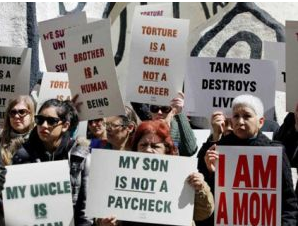
Screen Shot 2013-03-04 at 12.27.52 PMAs reported by James Ridgeway and Jean Casella in Mother Jones magazine, “On January 4, the Tamms Correctional Center, a supermax prison in southern Illinois, officially closed its doors. Tamms, where some men had been kept in solitary confinement for more than a decade, was notorious for its brutal treatment of prisoners with mental illness—and for driving sane prisoners to madness and suicide. The closing, sought by human rights and prison reform advocates was vociferously supported in demonstrations outside the prison’s gates ( for Mother Jones article, click on image on left photo image on the left).

What was surprising was the fierce opposition of big labor, even when all staff was promised continued state employment.The major force holding up the closure of  was the American Federation of State, County, and Municipal Employees (AFSCME), which, according to its website, represents 85,000 corrections employees nationally (as well as a total membership of1.6 million members. As well described in the Mother Jones article, prison unions and their partners in big labor have taken a more and more aggressive stance against prison closures. The article holds out some hope that the fissure between labor and prison reform cn be closed.


© 2007 -  Reentry Court Solutions. All Rights Reserved.


Reentry Court Solutions Powered by Communications Team