Systemic Approaches to Sentencing: Part 11

June 17,2012

Evidence Based Sentencing as a Hybrid System : Part 11

Evidence-Basd Sentencing Systems have been described in this series as problem-solving structures. More accurately they are hybrid courts that share the characteristics of traditional  sentencing courts as well as rehabilitative problem solving courts. While they emphasize the need for collaboration, they often start off in a traditional adversarial proceeding. This is particularly true when individuals are convicted of serious or violent offenses. In those cases, the court correctly views their primary responsibility as protector of the victim and community. Evidence-Based Sentencing Systems, as well as more traditional sentencing courts, incapacitate the violent and/or serious felon so they cannot continue their criminal activity, sentence to deter others from committing similar acts, and provide retribution against the offender who has done serious harm to the victim and community. Prison is a probability and even a necessity for many of these serious and violent offenders.

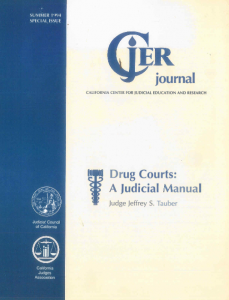
Evidence-Based Sentencing Courts move into problem-solving mode as the felon prepares to reenter the community. In Evidence-Based Sentencing Courts, judges and their teams develop effective structures that apply to all offenders sentenced in their jurisdiction (not just the non-violent). In fact, the structure inherent in an evidence-based sentencing team is designed to hold the offender, as well as collaborating agencies and community programs accountable for their effectiveness or lack of same. At the time Drug Court and Problem-Solving Courts were first  being developed, it was noted that, “In a “structurally accountable system”, participating agencies share program responsibilities and are accountable to each other for program effectiveness, with each participant directly linked to, dependent on, and responsible to the others (J Tauber, California Center For Judicial Education and Research Journal, Drug Courts: a Judicial Manual, Summer 1994; click on facimile on the left to review Section 30; on Structural Accountability).

In other words, If evidence-based sentencing practices are employed, coordination among relevant agencies and community organizations remains essential. Sentencing tracks are required to more effectively sentence and monitor offenders with very different risks and needs. While the sentences may be very different, the same level of coordination and collaboration is required when sentencing, monitoring, and rehabilitating the serious and/or violent offenders, as it is for the non-violent offender.


NADCP argues for Evidence-Based Tracks

June 12, 2012

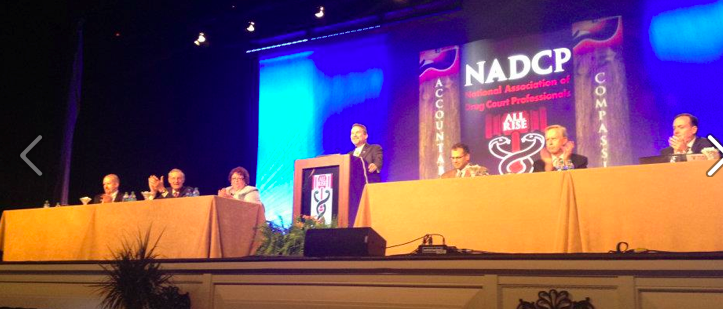
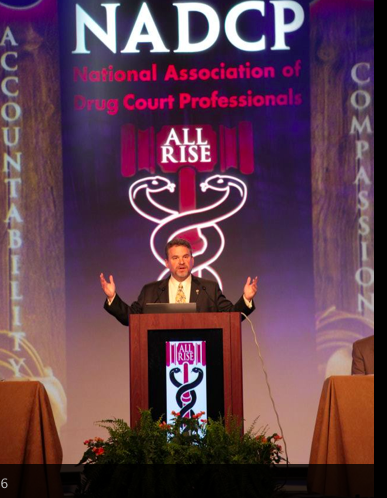
Dr. Doug Marlowe, NADCP Director of Science and Law is a clinical psycologist and attorney, widely acknowledged, as the foremost authority on the science behind Drug Courts and evidence-based Drug Court systems (seen in photo on left). At the NADCP conference in Nashville last week, he spoke at a number of workshops, attended by hundreds of attendees and moderated a plenary panel session whose participants were a who’s who of the drug court and drug treatment field ( “Reconstruction After the War on Drugs”). His two part Drug Court Practitioner Fact Sheets, Targeting the Right Participants for Adult Drug Courts  and Alternative Tracks in Adult Drug Courts: Matching Your Program to the Needs of your Clients, were the only documents included along with the conference agenda, provided to nearly 4500 attendees.

In his presentations and two part Fact Sheets he laid out a clear message for the drug court and the criminal justice field in general. Drug Courts are not for everyone. Only those individuals who are drug dependent ought to be placed in a drug court. Accordin g to Dr. Marlowe, sixty to eighty perccent of drug offenders in the criminal justice system, are drug abusers, not drug dependent, and don’t belong in a drug court.

In Fact Sheet II, Alternative Tracks in Adult Drug Courts: Matching Your Program to the Needs of your Clients, Dr. Marlowe further explains that developing alternative tracks in drug courts for non high-risk offenders probably make good sense. “In some communities the drug court may be the most effective, or perhaps only, program serving as an alternative to incarceration”. He concludes, “If a drug court has such compelling reasons to serve low-risk or low-need individuals, it should consider making substantive modifications to its program to accommodate the characteristics of its participants”. The document then describes “a conceptual framework and evidence-based practice recommendations for designing alternative tracks within a drug court to serve different types of adult participants”. All of this information should be of great interest, not only to the drug court practitioner, but to those interested in evidence-based sentencing systems, that provides appropriate tracks for different offender populations. In fact, both documents ought to be closely read for their import to sentencing in general (see:  Systemic Approaches to Sentencing: Part 10).

Now Available: Data on Court/Prisoner Jurisdiction

June 4, 2012

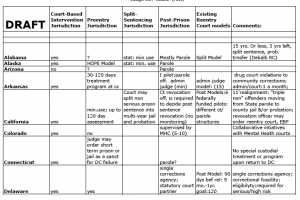
Click on the image below for a copy of the COURT-PRISONER JURISDICTION CHART 

Having just led a 3 hour training on the efficacy of Front-End or Early Intervention Reentry at the NADCP Conference in Nashville, I had the opportunity to address a meeting of State Drug Court Coordinators. Even though exhausted from the training, I  jumped at the chance to speak to policy makers and representatives of policy makers in their states. I described the potential of the Early Intervention Reentry Courts and the fact that I was happy to share my ongoing  research on where court-prisoner jurisdiction existed in states across the nation. [Clicking on the image on the left, will take you to the data on those connections].

I noted that since January, I’d contacted representatives from over forty-five states (many of them, the state coordinators themselves) to determine where court jurisdiction existed that might impact  persons in prison or those leaving prison. After looking at the data, a pattern emerged. There were relatively few states that gave their courts jurisdicition to supervise offenders after a completed prison sentence. But over 90% of states appeared to give their judges authority to recall an offender within a limited statutory period immediately after sentencing. Some individual judges or courts were doing this on a case by case basis, while others were using short term prison sentences systemically, as state policy to reduce prison terms for non-violent offenders (and prison populations). Texas, Ohio, Indiana, and Missouri are just four examples of states that are using their front end jurisdiction to recall offenders from prison (most often, within 3 to 12 months of sentencing) and return them to their communites for continued court supervision, as well as rehabilitation services. (see: Early intervention Reentry Makes its case at Conference)

As I finished my comments, i concluded by saying that It was my hope that policy makers and their representatives will take the opportunity to review the court jurisdiction chart above (though it is a work in progress) to learn what jurisdictional opportunities some state courts have used to reduce prison terms.

What I forgot to ask of the State Court Coordinators, I as of them and all of you now. If you have relevant information on your state’s court-prisoner jurisdiction (whether you are a policy maker or otherwise), please contact me with that information. Review the State/Prisoner Jurisdictional Chart above for errors or omissions, so that we can fill in gaps, and correct mistakes in the data provided.   We all need to better understand existing court-prisoner jurisdiction among the states, if we are to reduce prison terms for non-violent offenders’ and reduce prison over-population.

Systemic Approaches to Sentencing: Part 10

June 12, 2012

Dealing with the whole person in sentencing: Part 10

If you follow the comments of governors and other state policy makers these days, it appears that they have signed on to the notion that drug courts are the answer to prison overpopulation, high crime rates, and increased recidivism (and that may be the short list). In reading about their support for drug courts, I am cheered by their adoption of an important  innovation that I along with others pioneered over twenty years ago. And I am disheartened by their misunderstanding of the significance and applicability of drug court to one and all criminal offenders.

As described by Dr. Doug Marlow, at the 18th Annual NADCP Conference in Nashville  (see:  NADCP argues for Evidence-based tracks), most drug offenders are not drug dependent and shouldn’t be part of an intensive drug court program. In fact, according to Dr.Marlow, 60 to 80% of drug offenders do not need  a drug court’s intensive treatment. The majority of criminal offenders need to be treated as a whole person (not just a drug abusing person). As tempting as it may be to lock onto drug treatment as a silver bullet that works with all offenders, it isn’t an effective or cost- efficient tool for most criminal offenders (or even most drug offenders).

However that shold not conclude our analysis. If you look at the scientific literature on evidence based sentencing practices (click on image on the left,for a brief, comprehensive description of “Evidence Based Practices”), you’ll find that medium to high risk offenders have substantial criminogenic needs that need to be addressed, even if they’re not drug related.

“Criminogenic Needs” are functional impairments that if not treated, will increase the risk of further criminality. The top four such needs are a history of anti-social behavior, anti-social personality factors, anti-social cognitions/attitudes, and anti-social peers.Surprisingly, drug abuse is a second tier criminogenic need that only becomes a central concern if the offender is truly drug dependent or addicted., Otherwise, substance abuse treatment ranks  behind such second tier criminogenic needs such as family and/or marital stressors, employment and/or education deficiencies, and lack of pro-social leisure activities.

In practical terms, it appears that we over-treat drug abuse and pay too little attention to cognitive behavioral needs and rehabilitative therapies that have proven success in dealing with them. In essence what Dr. Marlowe and his scientific brethren have been telling us is Drug Court is not the answer to most offenders’ crimonogenic needs (although the better drug courts do not neglect them). Certainly drug courts can be modified (as Dr. Marlow suggests) to deal with the majority of criminal offenders, whose drug usage is not a primary criminogenic need. But it should be clear to all, that doing so may negatively impact drug courts and appropriate participants  As the old saw goes, if you just treat a criminal offender’s drug abuse, you might just create a healthier criminal. Better to deal with the whole person, in an evidence-based sentencing system, where their individual levels of risk and need are determined, and the appropriate supervision and treatment responses applied to them..

NADCP Conference Success is Complete

June 4, 2012

The National Association of Drug Court professionals 18th Annual Conference, was held last week in Nashville, Tenn.  Presided over by NADCP CEO West Huddleston, over 4000 attendees (an attendance record) filled Gaylord’s Grand Old Opry Hotel and Convention Center. I have been to all 18 National Conferences and found the energy  and confidence displayed to be inspiring.  To my mind, it was a powerful demonstration of the power of problem-solving courts to energize criminal justice reform across the nation (full disclosure: I was founding President of NADCP and am NADCP President Emeritus).

The Conference itself ran 23 tracks of 6 topic related workshops, ranging from Tribal Healing and Wellness Courts to Veteran’s Courts. Perhaps the most powerful session of the week was a plenary on Friday morning on “Reconstruction After the War on Drugs”, with Dr.Doug Marlowe, NADCP Director of Law and Science, moderating.  An mportant discussion ensued on the future of Drug Reform, now that the efficacy of treatment over imprisonment has become an article of faith among conservatives and liberals alike. On the panel were Judge Steve Alm, Dr. Robert DuPont, Melody Heeps, Chris Lowenkamp, Tim Murray, and NADCP CEO West Huddleston. The coming together of these seminal figures in the Treatment Court field is a good omen for the future.

Early Intervention Reentry makes its case at Conference

June 4, 2012

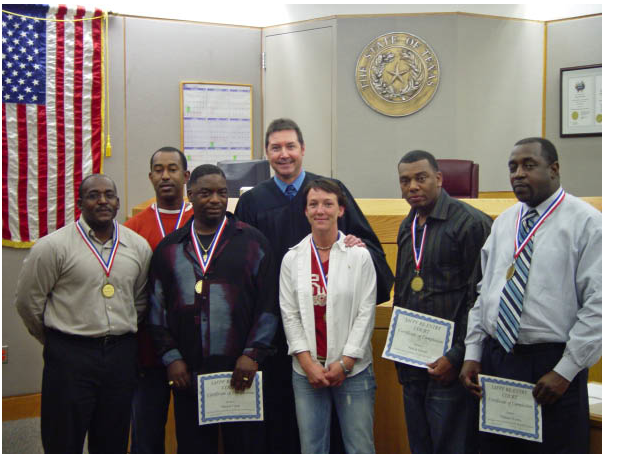
The Reentry Court field was well represented at the NADCP Conference with six workshop tracks and two 3 hour traing sessions on Front-End Reentry Courts and Federal Reentry Courts. Both 3 hour trainings and the track work shop on Front End or Early Intervention Reentry Courts were especially well attended and the audience was fully engaged by panelists from Dallas, Texan and Akron, Ohio. Both jurisdictions have reentry courts that are well established.(see photo to the left; Judge Bobby Francis and graduates of the Dallas Reentry Court program).

Though those courts were clearly successful Front End Reentry Court models, there were significant distinctions between them. Judge Francis’ Dallas program, determined eligibility at the time of sentence, with participants placed on probation and in a treatment program on prison grounds , but separate from prisoners. Judge Elinore Marsh-Stormer’s Akron program, relied on prisoners to initiate their program entry with a letter of request to the judge, and a court review process to determine their appropriateness, before they were released into the control of probation and the court. What both courts shared was an obvious dedication and enthusiasm for their work, and their ability to use their limited  jurisdiction to remove offenders from prison after only a fraction of their prison term, to be returned to the reentry court for further supervision, treatment, and rehabilitation services in their communities (see: Front Loaded Court Based Interventions),

Systemic Approaches to Sentencing: Part 9

May 28, 2012

Evidence-Based Sentencing Systems are Cost-Effective: Part 9

The previous eight articles in this series are testimony to the potential of evidence based sentencing systems. Scientific and technological advances now make these systems cost-effective as well. The most cost intensive aspect of any evidence-based system are the court hearings for felons sentenced to local custody and/or supervision. There is a misconception, that in an evidence-based sentencing system, all felons would be seen in court on a regular basis (as most problem-solving courts tend to do). But science and technology has provided us with strategies and solutions that allow us to substantially reduce the need for additional court sessions and staff (the “Risk Principle”).

Validated risk/needs assessment tools developed over the past ten years allow us to determine a felon’s risk levels and how to best deal with the offender ( see “University of Cincinnatti Study on Risk Principle”) We now know that intensive supervision for low to medium risk offender (involving multiple appearances before the court) actually increases their levels of recidivism. In some jurisdictions, that understanding may actually reduce the total number of court appearances, as only those who have been determined to need intensive supervision and court monitoring would receive it. Felons who are traditionally “banked” as low-risk probationers would almost certainly be excluded. Those offenders who are considered medium risk offenders might be seen by the court on a very limited basis (perhaps one court appearance after beginning their jail sentence, with a second at the start of active probation supervision and a third at the completion of successful probation supervision). Depending on criminal background, history of violence, extent of imprisonment and other relevant factors, high-risk felons would be placed in an appropriate supervision and court monitoring track. (see video at bottom of article, for interview with Reentry Court judge Jeff Tauber, on the intensity of supervision and rehabilitative track required by serious and/or violent high risk parole violators)

A more universal fiscal concern relates to the over-staffing of problem-solving courts. The fact that many courts have more than a dozen employees attending staff meetings and court sessions is a major financial obstacle to the expansion of evidence-based sentencing systems (and other problem solving courts as well).  My experience as both a drug court and reentry court judge suggests problem-solving courts are often over-staffed ( see: A Minimalist Reentry Court for Recessionary Times). My Drug Court staffings in 1990 (admittedly a long time ago) had two persons present, the probation officer personally responsible for offenders to be reviewed, and myself. In a more recent experience on the Bench (2010-2011) , the San Francisco Parole Reentry Court operated with a staff of five; judge, program coordinator, case manager, defense attorney, and parole officer. It should be acknowledged that every problem-solving court has its own staffing requirements,  but the tools described above can also help keep court personnel to a minimum. The development of risk/needs assessment tools allows us to better categorize probation/parole offenders, placing them in customized court tracks, limiting the court time of program specialists, to sessions where their skills are truly needed. Similarly, technology allows us to share information and communications between program personnel and staff, limiting  the need for those present in court.

Finally, even problem-solving courts with significant operating cost, have shown themselves to be cost-effective (see California Study), substantially reducing custody and other criminal justice costs, and providing enormous savings to the community as a whole. This will undoubtedly be the case for evidence-based sentencing systems as well.


If your ‘re in Nashville this Week, Come on by and say hello……….

May 21, 2012

I’d like to invite those of you planning on coming to NADCP’s Nasville conference this week, to join me and my colleagues presenting at the Reentry Court Training and Workshops.

I’ll be leading a wonderful group of presenters from Akron and Dallas in a three hour training on Front-End Reentry Courts (Early Intervention courts)  on Wednesday May 30th from 9:00AM to Noon (SB-1; Bayou C)]

And I’ll be moderating a panel session on Front-End Reentry courts that will be held on Thursday, May 31st, from 10:30 to 11:45. It will be Workshop A13: Governor’s Ballroom D, the first workshop of the conference.

Finally I’ll be presenting on Evidence-Based Sentencing Systems, the future of the Problem-Solving field on Friday, June 1st, from 4:30 to 5:45 in the afternoon, in Room F13; Governor’s Ballroom D. 

Note:  The June 1st session is described incorrectly in the broshure as being on “Commnity-Based Reentry Courts”; It will partially be on that topic, but mostly be devoted to the larger subject of “Evidence-Based Sentencing Systems” (the subject of a 12 segment series of articles on RCS)

Join in on our sessions or just come by and introduce yourself. 

Systemic Approaches to Sentencing: Part 8

May 21, 2012

Reducing Prison terms through Front-End Sentencing: Part 8

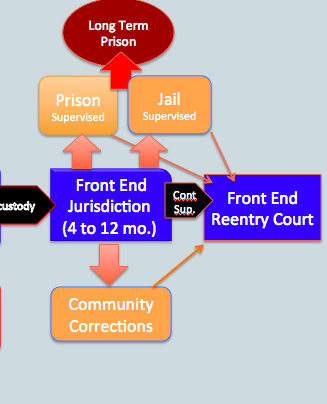
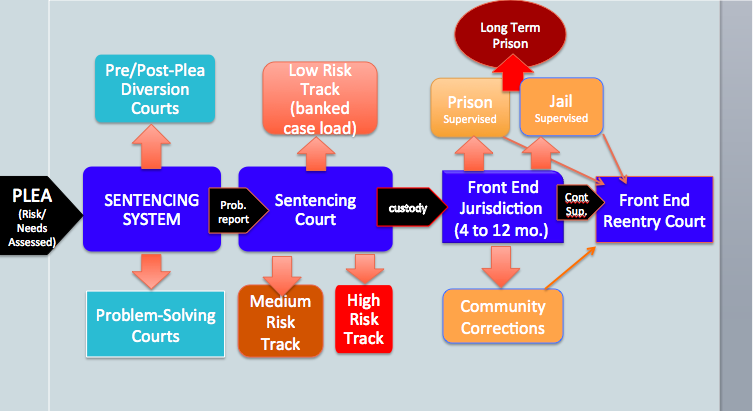
The diagram on the left represents the second half of a sentencing system envisioned, allowing us to use an evidence-based sentencing system as a means to keep serious (but non-violent) offenders from serving long prison terms  (Composition of a Sentencing Track: Part 6).

As described in previous articles (see: Front-Loaded Court Based interventions), the front-end of a prison sentence provides the only substantial opportunity a court has to effect a prison term, once a felon is sentenced. Few courts use that statutory authority to return the felon from prison. When used at all, the authority is often applied in a non-systemic fashion, with individual judges operating on their own.

“Front-End Systemic Approaches” to long prison terms described here, (compare: Decision Making in a Sentencing system: Part 7)  presents an opportunity to use graduated sanctions rather than immediate prison sentences for serious, but not-violent offenses. Such Front-End Systems can be structured in different ways. Some courts may include non-prison sentences (typically county jail or community corrections programs) as part of an “alternatives to  prison” system.

Systemic approaches to “Front-End Alternatives to Prison”, might start with a Community Corrections level alternative sentence. With new offenses and/or serious violations of probation, they might move up to a county jail alternative, and finally to a short term prison sentence in lieu of a long term prison sentence. Depending on the seriousness of the offense, an offender might start a  “Front-End”  Intervention at any of the the three levels described. The flexibility inherent in a three tier front end/early intervention system is impressive, as is its ability to respond to the safety of the community and the needs of the offender:

A.  Community Corrections Sentence in lieu of Prison: Less often used than other alternatives, this community based alternative to prison (typically residential treatment or correctional housing while an offender receives education, job training or employment), allows the judge to closely follow the offenders participation in a community based program, providing incentives or sanctions as appropriate. With successful program completion,the participant is returned to the community to continue supervision and rehabilitation under court authority. [Note: this alternative can be the first of two used before the offender is ordered to serve any prison sentence]

B. County Jail Alternative: This second tier “Front End Prison Alternative” can better emphasize the risk that the felon has of being sent to prison. Like the “Community Corrections Alternative, the County Jail Alternative  allows close monitoring  by the sentencing judge, appropriate incentives and sanctions, and a return to the community for further court supervision.

C. Front-End Prison Term: This ought to be thought of as a felon’s last opportunity to avoid a long prison term. Depending on the seriousness of the offense, some jurisdictions will start the Front-End Sentencing process with a prison term (skipping over possible Community Corrections and County Jail level interventions), hopefully reducing a long term sentence to a relatively brief 4 to 12 months in prison, and returning the felon to the community to complete the sentence under court supervision.

Next week’s segment will show how systemic sentencing can be provided at  minimal cost

Candidates vie for Drug Court Post

May 21, 2012

On the far right is an article regarding an election between three candidates competing for Drug court judge in Fayetteville Arkansas (click on: Washington county).  When I started the Oakland F.I.R.S.T Drug court in 1990 ( Fast Intensive Rehabilitation, Supervision and Treatment), there was no one to compete with because no one knew what a drug court judge did. When they learned what the job entailed, few were particularly interested in being one.  Today there are over 2,644 Drug Courts (and drug court judges) and an additional 1099 Problem-solving courts in the U.S.

From those numbers, it would appear that we’re on our way to a future dominated by Problem-Solving courts. While it’s true that states are building new Problem-Solving Courts, but they’re also severely limiting the number of participants. It is estimated that no more than two percent of all felony offenders who are sentenced enter into a problem-solving court.

To have a real impact on the criminal justice system, we will need to deal with all sentenced felony offenders (and perhaps some misdeameants). Doing that will require a very different sentencing model than exists today. All convicted felons would need to go through a validated risk/needs assessment to determine their level of risk to recidivate and consequently the intensity of supervision and treatment required. Because we can predict with greater accuracy who are the high risk offenders, we can concentrate our resources on those individuals. Of course, the corollary is that the low risk offender would receive little or no supervision or treatment, as science tells us that the alternative would only increase their level of recidivism.

I am referring to an “evidence-based sentencing system” that would engage those offenders that require it and leave alone those who do not. A very selective and cost-effective model that has been tried in a very few jurisdictions, and has the promise of revolutionizing the sentencing process. We are entering  new era, ultimately far more important than the one begun 20 years ago.   It will be critical to keep our eye on the goal of systemically working with all felons and not just drug-offenders. And to accept the challenges posed of providing  evidence-based sentencing systems for all. (see Approaches to Sentencing Systems: Parts 1-8)


Systemic Approaches to Sentencing: Part 7

May, 13, 2012

Decision Making in a Sentencing System: Part 7

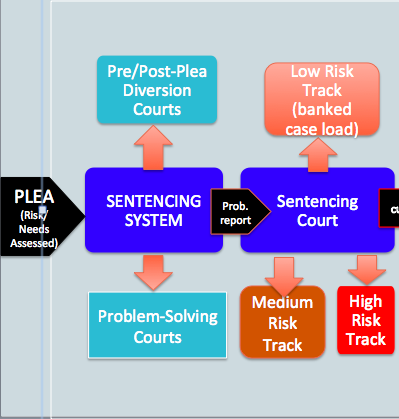
The diagram on the left represents the first half of a sentencing system envisioned, allowing us to take a closer look at decision making in an evidence based  sentencing system (Systemic Approaches to Sentencing: Part 6):

Offender Tracks are normally the province of Probation or other supervisory agencies. When used at all,  they reflect internal decisions in determining the level of supervision and treatment appropriate for a probationer.  With validated Risk/Needs Assessments available, the final decision as  to court related tracks ought to be left to the court, based upon the recommendations of the full sentencing team.  Court tracking is essential to keep offenders with similar risk and needs together, maximizing the opportunities for building positive relationships with the court and participants and limiting the negative consequences of mixing offenders with different risk levels.  The court will need to schedule tracks when required staffing and resource personnel are present. Optimally, the only personnel present at all sessions will be the judge, clerk, and court manager.

 As described in the demonstrative Diagram, the following evidence-based tracking system is offered for your consideration:

a. A risk assessment is completed even before sentencing and optimally before a plea is taken so all parties will have an understanding  of the sentencing issues early on. ( ideally, the level of treatment/rehabilitation or appropriate track designation should not be the subject of a plea agreement).

b. An individual may be given the opportunity to accept pre-plea Diversion (often called District  Attorney’s Diversion). Once a complaint is filed, the court has substantial control over pre-plea and post-plea felony Diversion, as well as pre and post-plea  Problem-Solving Courts. A Diversion or Problem Solving Court Court judge typically takes a plea, sentences the offender, monitors the offender over the course of the program (including in-custody progress), and presides over their graduation from the program.

c. The lead judge (or a designee) takes the plea in most other felony cases, reviewing the risk/needs assessment already completed, and sentences the felon either to probation or to  prison (if the offense is violent or the offender a danger to the community). If the offender is appropriate for probation , the sentencing judge will decide whether the felon should be placed in a low, medium or high risk supervision track. Depending on the number of offenders and resources available, there could be sub-tracks within each risk category (when offender’s needs differ substantially in  criminogenic attitudes and beliefs, gender concerns, drugs or alcohol problems, mental health issues, housing,  job and/or education needs, and family/ parental issues)

1. Low risk offenders; Probation (banked file): Where the offender is neither a risk to society or has special needs, the court might see the offender once, shortly after probation placement, focusing the offender’s attention on probation compliance,  and only see the felon again, if there is a substantial change of circumstances or graduation (note: Diversion contacts are often as minimal).

2. Medium risk offender, Probation (straight community corrections); Where the offender has a medium risk of re-offending and has special criminogenic needs, the felon would be placed in a track on a regular court schedule. Compliance in this track would require completion of cognitive behavioral and other rehabilitation services, with compliance resulting in substantial incentives and rewards. Compliance will allow the court to back off from contacts with probationers (unless changed circumstances or graduation)

3. High Risk offender, Probation (often a substantial jail term); Intensive supervision requirements might include attending court sessions on a weekly basis (remaining in court until all participants have been seen), a minimum of twice weekly contacts with a case manager, intensive cognitive behavioral therapy sessions, and prosocial activities for atleast 40 hours per week (for at least 90 days)

 The next segment will look at the ability of  local jurisdictions to use brief prison terms in sentencing


Systemic Approaches to Sentencing: Part 6

May 5, 2012

The Components of the Sentencing Track: Part 6

The  diagram above can be thought of as two separate segments. The first (from “Plea” arrow to “Custody” arrow) focuses in on the need to effectively categorize, sentence, and track offenders, with a minimum of staff and resources. Tracks are essential to the system as the court will sentence and monitor offenders with very different risks and needs. A sentencing team with a different skill set is required to deal with low risk and diversion participants than with high risk and violent offenders (as a different team skill set would be required for Drug Court as opposed to Domestic Violence Court).

We know from the scientific literature (“Understanding the Risk Principle”), that mixing low and high risk offenders is counter-productive at best. That same dynamic works in the court room. Where possible, it’s best to keep participants with different risk levels apart. It’s also more cost-effective. Why have full staff at every session when you can substantially reduce the number of staff by sorting offenders by risk and need. When you create a  participant track with few housing, job, or family issues, experienced staff in those areas can best use their time elsewhere. The savings would be substantial if case managers are designated to be in court once a week for a single track, rather than required to attend daily sessions

The second part of the diagram (from “Front End Jurisdiction” to Front End Reentry Court”) focuses on the potential for an “Early Intervention”. We focus on the front end  because almost all states give their courts a window to recall the felon from prison within a relatively short  time period  (typically 4 to 12 months).  Where courts are willing to use their statutory authority, serious and/or high risk offenders can complete a rehabilitation program over a short jail or prison term and avoid a long prison sentence. The opposite is true for felons sentenced to long prison terms (or even medium terms of 1 to 3 years). In most states, there is relatively little opportunity for a court to exercise authority over the “Back End”, as the felon, typically returns to the community under state supervision (see: Front Loaded Court Based interventions) .

The next segment will look at how decisions are made in an evidence-based Sentencing System 

Front End Reentry Court Training; at NADCP Conference

May 5, 2012

A spcial training session focusing on the effectiveness of Front End/Preentry/Early Intervention Reentry Courts will be held on May 30th from9:00AM to Noon at the NADCP Conferendce in Nashville, Tennessee (SB-1; Bayou C)

[for conference registration information; May 30 – June 1: click here]

If you are interested in how Front End Reentry Courts could work in your jurisdicition and state, this is your opportunity. The training will be led by Judge Jeff Tauber (ret.), NADCP President Emeritus and Judicial Fellow in Reentry Courts and Evidence Based Sentencing. Practitioners from both the Dallas and Akron Reentry Courts, as well as national experts, will provide insights and practical information as to how Front End Reentry Court work in your jurisdiction and across your state. (At left, see Dallas Judge Bobby Francis and his SAFPF Court graduates)

Find the description for the training in the Conference agenda below:

FRONT-END REENTRY COURTS; A HALF DAY TRAINING (May 30, 2012; 9AM-12 Noon)

The states are looking for ways to reduce long term prison sentences. A number of state courts have developed effective “reentry courts” based on limited state jurisdiction that exists at the front end of a prison term. Called  Front End, Preentry, or Early Intervention Reentry Courts (depending on your locality), they capitalize on the courts ability to recall prisoners for resentencing within the first several months of a prison sentence (typically less than six months). These programs provide a seamless transition between in-custody treatment, court supervision, and community rehabilitation.

Learning Objectives:

a. Learn how Front End Reentry Courts have used existing jurisdiction and authority to create comprehensive reentry courts that combine the control of a prison sentence with the promise of court supervision and community reintegration.

b.  Learn how prison and community- based supervision and rehabilitation are coordinated in a seamless fashion that successfully reintegrates offenders into the community at a fraction of the cost of long term prison sentences.

You will receive first hand information on:

1.   Jurisdictional issues in starting front–end programs; program development both in and out of prison, levels of contact between court and prisoners, and sentencing structure.

2.    What happens in prison ( jail or a community corrections facility); what do the participants get out of brief custodial term, is there treatment, rehabilitation, and/or educational services while in custody, is there judicial oversight and/or incentives?

3.    What triggers a recall to the court for resentencing, what level of compliance is required for the prisoner to be allowed back into the court and community. What does the post prison court program look like and who has jurisdiction. What success have Front End Programs had?

[Note a separate single workshop on Front-End Reentry Courts will be held on Thursday, May 31st, from 10:30 to 11:45 at the NADCP Conferernce. It will be Workshop A13: Governor’s Ballroom D, the first workshop of the conference]


New Workshop Added: “Systemic Approaches To Sentencing”

A new Workshop has been added to the Reentry Court Workshop Track, from 4:30 to 5:45 on June 1st at the NADCP Conference in Nashville. The 6th and last workshop session. it will demonstrate how “Systemic Sentencing Approaches” create a seamless process that follows the sentenced offender from sentencing thorugh custody, to community supervision, reducing recidivism and court costs, while improving the court’s capacity to provide effective rehabilliation and monitoring.

The workshop will be presented by Judge Jeff Tauber (ret.), President Emeritus of NADCP. editor of Reentry Court Solutions, and  most recently, the judge in San Francisco’s Parole Reentry Court Demonstration Project.

[Note: the Workshop will be held in Room F13; Governor’s Ballroom D. The Workshop is incorrectly entitled,  “Using Court-Based Community to Build Successful Reentry Courts”]


Systemic Approaches to Sentencing: Part 5


April 30, 2012

Court Monitoring of Sentence Tracks: Part 5

Courts can deal effectively with all their sentenced felons, by developing comprehensive “evidence-based sentencing systems” (see Arming the Courts with Research: , Roger Warren, Pew, 2009). Traditionally, we classify, categorize, and sort felons into appropriate groupings at every step of sentencing process.The Sheriff decides an inmate’s housing category. The probation departments recommends whether a probationer should be intensively monitored or placed in a banked case load. The court  determines whether a felon is to be placed on probation or sent to prison.(Click on image to the left for Development and Implementation of Drug Court Systems,JTauber,NDCI,1999)

Today’s problem-solving courts have led the way in in the use of assessments (and other evidence based sentencing practices)  to improve our sorting or categorizing and thereby our sentencing outcomes. The court and its systemic partners determine if an offender needs special rehabilitation, treamtment, or education as part of the sentencing process. So a DUI offender with a third offense might require a residential alcohol treatment program, the domestic violence offender, an extensive series of violence reduction classes, and the drug offender, completion of a appropriate drug treatment program. In each instance, the court will continue to monitor the offenders at progress report hearings until the relevant conditions of probation are completed.

To optimize the effectiveness of a sentencing court’s monitoring of all felony sentences (see: Systemic Approaches to Sentencing: Part 3), we now use a more comprehensive process, a validated risk/needs assesssment, to sort the offenders into appropriate tracks.  A felon is  determined to be a low, medium, or high risk offender. Depending on that determination, an individual is placed in different probation, treatment or rehabilitation tracks, with  the court actively monitoring those tracks on an regular schedule over the term of probation (and in some cases parole).  In effect, a “special sentencing team”, led by the sentencing judge, follows all offenders placed in sentencing tracks,  as they move seamlessly through sentencing and custody (where ordered)  and into the probation process.

It should be remembered, that though all felons are categirized and placed in tracks, that very process is intended to increase the court’s effectiveness, by limiting the court’s contact with the low risk/low needs offenders. If the sentencing court is to effectively deal with all felons, it will need to distinguish between those who require the court’s attention and those that are best left alone. Substantial savings in time, staffing, and resources lie in the court’s effective and appropriate tracking of  sentenced offenders.

The next segment will look at how sentencing tracks work in a systemic sentencing court.

© 2007 -  Reentry Court Solutions. All Rights Reserved.


Reentry Court Solutions Powered by Communications Team